
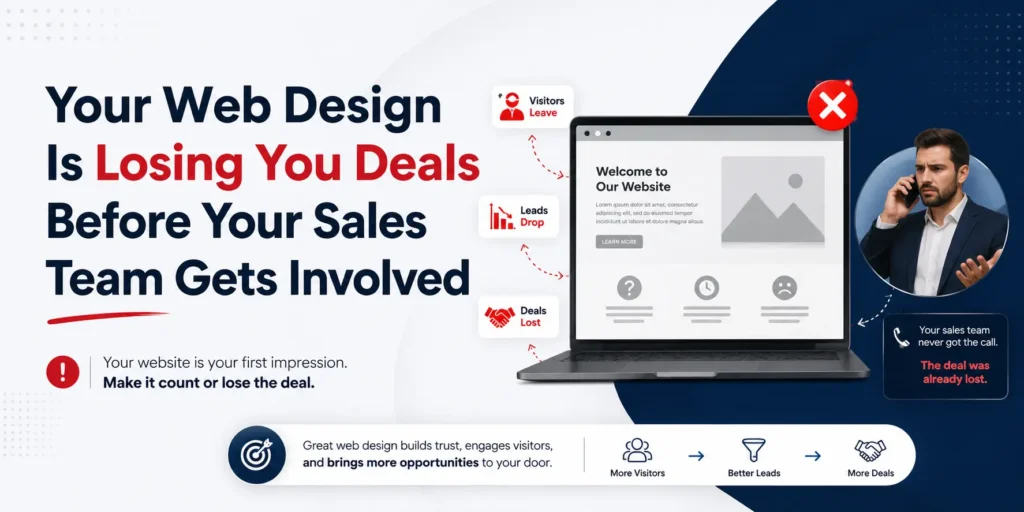
Web Design Investors funded your product, not your homepage — but your homepage is the first thing a prospect, enterprise buyer, or potential hire sees, and bad kills deals that your team never even knows existed.
Web Design Directly Impacts Pipeline, Not Just Perception
Stop treating as a branding exercise. It is a revenue function.
Forrester Research found that every $1 invested in UX returns $100 on average — a 9,900% ROI. That number feels extreme until you walk through the math at your stage. You close a $50K ARR deal. Web Design Your site conversion rate is 2%. If improved lifts that to 3%, you add 50% more pipeline from the same ad spend, the same SEO, the same content. You pay your sales team nothing extra.
Stripe’s original B2B set the benchmark for developer-focused companies. Their documentation pages, their pricing layout, their API reference — all of it was product-quality web design deployed as marketing. The result? Developers trusted them before making a single API call. built conviction faster than any sales deck.
At Series A, you compete against companies with larger teams and bigger budgets. is one of the few levers that punches above your weight class. A $40K investment in web design improvements outperforms $200K in incremental paid acquisition if your existing traffic converts at 1% instead of 3%.
The Three Web Design Mistakes That Kill Enterprise Deals
Enterprise buyers behave differently from SMB buyers. They screenshot your pricing page, send it to legal, and forward your homepage to a VP before your AE sends a follow-up. Your web design communicates credibility — or destroys it — in seconds.
Mistake one: generic SaaS templates. If your site uses a Webflow template that 4,000 other companies also purchased, procurement teams notice.that looks identical to your competitor signals low differentiation at the product level, even when your product is genuinely better. Figma built their entire brand on distinctive web design. Their site looked and felt like a design tool, not a marketing site — that coherence was itself proof of product quality.
Mistake two: navigation that assumes familiarity. Your prospects do not know your product taxonomy. If your buries the use case most relevant to an enterprise buyer behind three clicks, they leave. Gong redesigned their navigation architecture in 2021 to lead with outcomes (“more revenue,” “fewer deal risks”) rather than features. Inbound enterprise inquiries increased measurably. Navigation. Information architecture.
Mistake three: mobile web design treated as an afterthought. Your ICP is a VP at a mid-market company. They open your site on their phone during a commute. If your breaks below 768px, you lost them before your SDR sent the outreach. Google’s Core Web Vitals directly affect your search ranking, and 70% of those signals come from mobile web performance. Poor mobile costs you both deals and organic traffic simultaneously.
What Good Web Design Actually Costs at Series A
Budget clarity matters, so here is a realistic framework.
A full engagement with a strong agency — strategy, UX, visual design, development — runs $80K–$200K and takes 12–20 weeks. That investment makes sense if you have established messaging, a defined ICP, and existing traffic above 20K monthly visitors. The ROI calculation is straightforward: if your average contract value is $30K and you close 10 more deals per year from improved conversion, you generated $300K in new ARR from a one-time investment.
For founders who need results faster, a targeted sprint costs $15K–$40K and focuses on three high-leverage pages: homepage, pricing, and one key solution page. Basecamp’s Jason Fried built a framework for this approach — fix the pages that receive the most traffic and have the clearest conversion intent first. This approach delivers measurable results in 6–8 weeks.
In-house works when you have a product designer who also understands marketing psychology. Most Series A companies do not. Forcing your product designer to own optimization splits their focus and produces mediocre results in both areas. Hire a contract specialist or engage an agency for the marketing site. Keep your product designer focused on the product.
One number to benchmark your current web design performance: if your homepage-to-trial conversion rate falls below 2%, your web design has a quantifiable problem. HubSpot’s data across 100,000+ company websites shows that top-quartile B2B SaaS sites convert homepage visitors at 3.5–5%. That gap represents recoverable pipeline.
Web Design Decisions That Compound Over Time
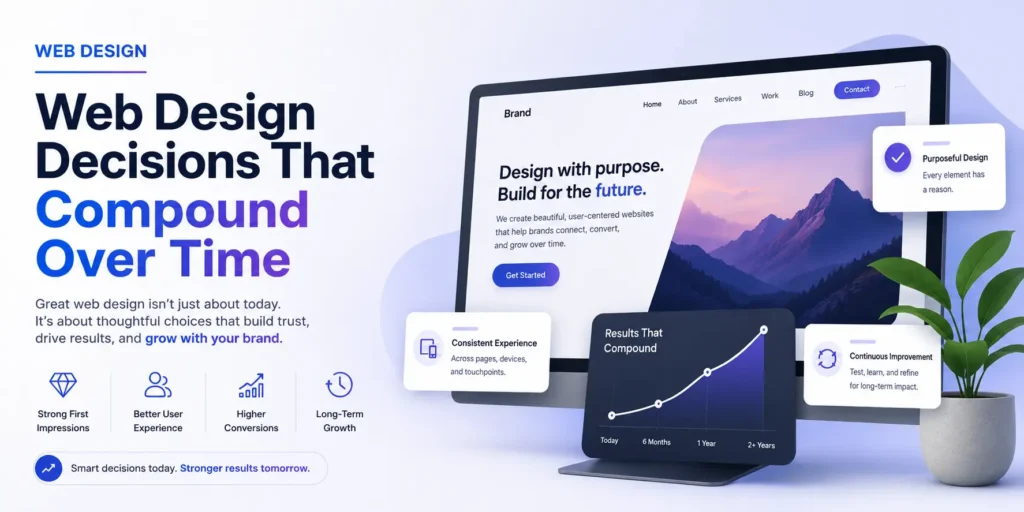
Web design is not a one-time project — it is a system that either compounds or decays.
The companies that win on web design establish a design system early. Vercel, Linear, and Notion all built internal component libraries that made web design iteration fast. Every new landing page, every campaign microsite, every product update page got deployed in days instead of weeks because the web design foundation was solid. They shipped faster than competitors and maintained visual coherence at scale.
The inverse happens too. Technical founders defer web design investment, accumulate design debt, and end up with a Frankenstein site — three different navigation patterns, four different button styles, inconsistent typography across pages added by three different contractors. Cleaning that up costs more than building a system correctly the first time.
Treat your web design as infrastructure. Establish a design system with documented components, tokens, and usage guidelines. Require new pages to use that system. Review web design quality quarterly the same way you review engineering code quality. Web design debt compounds exactly like technical debt.
Personalization represents the next frontier in web design ROI. Companies like Mutiny and Intellimize allow B2B SaaS companies to serve different web design experiences to different segments — enterprise visitors see enterprise-specific social proof, SMB visitors see different pricing signals. Carta and Segment used this approach to increase demo request rates by 30–60% without changing a line of their core web design. Dynamic based on firmographic data is table stakes for Series A companies competing for enterprise contracts.
Web design is not a cost center — it is a conversion machine running 24 hours a day without quota. Fix it before you hire your next five salespeople.
Written By sumitmarketing.com