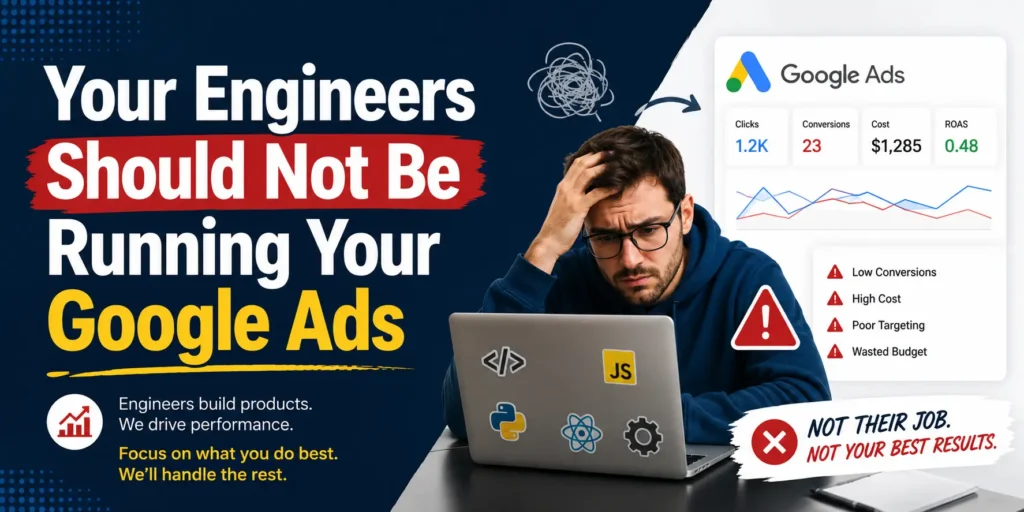
You raised a Series A to build product — and right now, your best engineers are debugging UTM parameters instead of shipping features, because you haven’t hired a digital marketing agency yet.
Why In-House Marketing Burns Your Runway Faster Than You Think
Technical founders default to building everything in-house. It works for product. It destroys you in marketing.
Here’s the math. A senior growth marketer in a major US metro costs $130,000–$160,000 base salary in 2024, plus equity, benefits, and three to four months of ramp time before they produce anything measurable. A mid-tier digital marketing agency retainer runs $5,000–$15,000 per month and activates within two weeks, bringing a team that already has paid media specialists, SEO strategists, conversion rate optimizers, and copywriters under one roof.
Figma’s early growth team leaned heavily on agency support before scaling in-house — not because they lacked talent, but because agencies deploy faster. At Series A, speed is the only advantage you have over better-funded competitors. A digital marketing agency gives you a full growth function in week three. A single hire gives you one generalist still learning your product in month four.
Beyond cost, there’s capability breadth. A paid acquisition specialist who has run campaigns for 40 B2B SaaS companies recognizes your specific losing pattern — high CTR, low conversion, wrong ICP targeting — in day one. Your first in-house hire figures that out in month six. That gap costs pipeline.
The argument against agencies — “they don’t know our product” — is a training problem, not a structural one. You solve it with a rigorous onboarding doc and a weekly 30-minute sync. You do not solve slow agency speed with a full-time hire who takes equity and a benefits package.
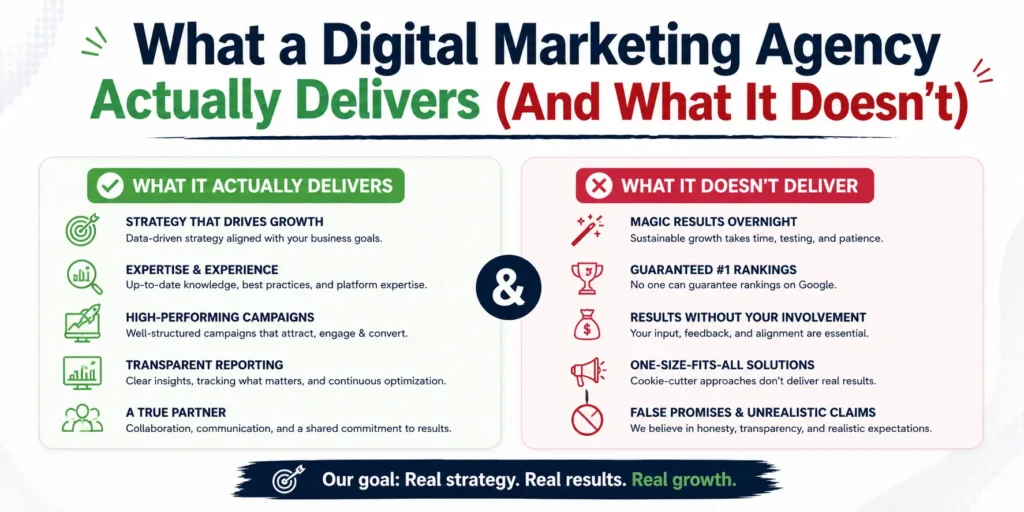
What a Digital Marketing Agency Actually Delivers (And What It Doesn’t)
Stop evaluating agencies on deliverables. Evaluate them on feedback loops.
The right digital marketing agency runs structured experiments with defined success metrics before spending your budget at scale. They ship a creative test with five ad variants in week one, kill three by week two, and double down on the two that hit a sub-$40 cost-per-lead by week three. That cycle — hypothesis, test, kill, scale — compounds faster than any single hire can manage alone.
Concrete deliverables from a performance-focused digital marketing agency in months one through three should include: a full-funnel audit of your existing traffic and conversion data, a paid media playbook specific to your ICP, three to five landing page variants with A/B test results, and a baseline attribution model that connects top-of-funnel spend to closed revenue. If an agency cannot show you those outputs in the first 90 days, fire them.
What agencies will not do well: product-level content that requires deep technical knowledge, community building that demands authentic founder voice, and analyst relations that hinge on personal credibility. A digital marketing agency amplifies distribution. It does not manufacture brand trust. That part is still your job.
Drift, before its acquisition by Salesloft, used agency support specifically for paid acquisition and SEO while keeping thought leadership content internal. That division of labor let their team publish founder-level insights while the agency scaled the reach. The result was a brand that felt both authoritative and discoverable — a combination that neither side could have produced alone.
How to Evaluate a Digital Marketing Agency Without Wasting Three Months
Most agency selection processes are backwards. Founders ask for case studies, get impressed by logo slides, sign a six-month contract, and discover the bad fit in month two.
Run this filter instead. Ask every digital marketing agency candidate three questions before you review a single portfolio piece:
One: What is your process when a campaign underperforms in the first 30 days? Good agencies describe a kill-and-pivot framework with specific decision thresholds — “if cost-per-acquisition exceeds $X by day 21, we reallocate budget to the next hypothesis.” Bad agencies say “we optimize continuously,” which means nothing.
Two: Who actually works on our account? Many large digital marketing agency firms sell you on senior leadership, then hand you to a junior analyst. Demand the names and LinkedIn profiles of the three people who will touch your campaigns daily. Verify their experience matches your channel mix.
Three: Can you show us a campaign that failed and what you learned from it? Agencies that share failures have a genuine testing culture. Agencies that only share wins are selling you a highlight reel. You want a partner who treats a $3,000 failed experiment as data, not as something to hide.
Proof of fit also comes from vertical specificity. A digital marketing agency that has worked with three to five B2B SaaS companies at your stage understands that your sales cycle is 45–90 days, that your buyer reads G2 before they read your website, and that LinkedIn outperforms Meta for your ICP. An agency with a generalist client roster will learn all of that on your dime.
Negotiate milestone-based contracts with a 30-day exit clause in the first 90 days. No credible digital marketing agency will refuse that term if they believe in their own performance.
The ROI Benchmarks That Should Drive Your Decision
Numbers you can hold agencies accountable to — sourced from HubSpot’s 2024 State of Marketing Report and Databox benchmark data.
B2B SaaS companies spending $15,000–$30,000 per month on managed paid media through a specialized digital marketing agency report a median pipeline-to-spend ratio of 6:1 in months four through six, once campaigns have sufficient optimization data. Below a 4:1 ratio after month five, you either have a channel fit problem or an agency performance problem — both require immediate action.
SEO-focused digital marketing agency engagements produce slower but more durable returns. Organic traffic from a well-executed content and technical SEO program begins compounding at month four and typically reaches positive ROI by month nine. If your sales cycle exceeds 60 days, organic content is not slow — it’s aligned to your buyer’s research timeline.
For conversion rate optimization, a competent digital marketing agency should produce landing page lifts of 15–40% within the first 60 days through structured A/B testing. Anything below 10% improvement on a page with sufficient traffic volume signals the agency is optimizing aesthetics, not conversion psychology.
Attribution remains the hardest ROI problem. Require any digital marketing agency you hire to implement multi-touch attribution from day one, not last-click. The difference in what you measure — and therefore what you scale — determines whether your marketing budget compounds or evaporates.
The fastest Series A companies don’t debate whether to hire a digital marketing agency — they debate which one gets the best-fit brief. Decide this quarter, not next year, because every month you delay is a month your competitor’s pipeline grows while yours waits on a job posting.
Written By sumitmarketing.com