
On 15 October 2026, UPI starts charging merchants for the first time since 2020, and that fee still leaves UPI payments as the cheapest, fastest-converting checkout rail your team can ship this quarter.
The volume already sits where your customers are
NPCI reported 24.51 billion transactions worth ₹29.82 lakh crore in August 2026 — the platform’s highest month ever, up roughly 22% year on year, averaging 791 million transactions a day. For the full FY 2025-26, UPI cleared about 24,162 crore transactions, a 30% jump, and NPCI’s decade report puts the rail at roughly 85% of India’s digital payments. The IMF calls it the world’s largest real-time payment system by volume.
Those numbers matter to you for one reason: you spend nothing teaching an Indian customer how to pay. Every other rail asks the buyer to fetch a card, remember a CVV, and survive an OTP page. UPI payments ask for a thumbprint. When your funnel already leaks at checkout, removing four steps beats another round of copy tests.
Ticket sizes keep falling while volume climbs, which tells you the rail reaches beyond metros — useful if your growth plan depends on Tier 2 and Tier 3 users who never held a credit card. Analysts peg India at roughly 49% of global real-time payment volume, more than three times Brazil’s Pix. You will not find a second distribution channel with that density sitting behind a free API.
Founders who treat UPI payments as an afterthought usually inherit a checkout built for a Western card funnel, then spend two quarters explaining a 40% drop-off to their board. Flip the default instead: put UPI payments first in the payment selector, keep cards as the fallback, and watch which one your users pick.
Run the MDR math before you panic
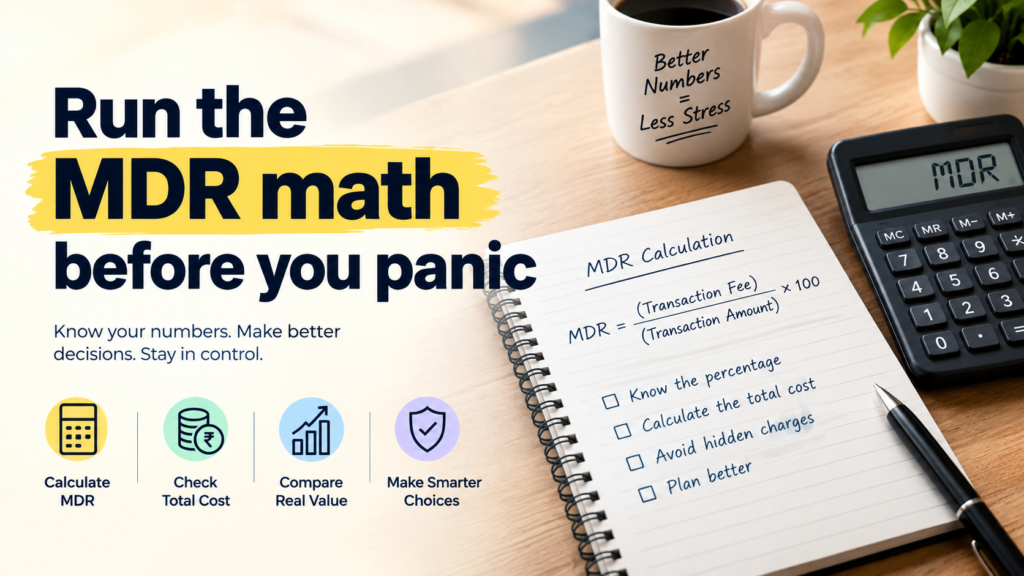
NPCI’s UPI and Services Steering Committee finalised a merchant discount rate of 0.4% on person-to-merchant transactions above ₹2,000, effective 15 October 2026. Payments of ₹75,000 and above carry a flat cap of ₹300. Person-to-person transfers and every P2M payment up to ₹2,000 stay free, and NPCI says small merchants who collect up to ₹1 lakh a month through UPI QR keep zero MDR. NPCI also puts sub-₹2,000 payments at more than 95% of P2M volume today.
| Ticket | MDR you pay | Effective rate |
|---|---|---|
| ₹1,800 | ₹0 | 0% |
| ₹3,000 | ₹12 | 0.40% |
| ₹50,000 | ₹200 | 0.40% |
| ₹2,00,000 | ₹300 (capped) | 0.15% |
Read the shape of that table. The fee on UPI payments falls as your ticket grows, which inverts how card pricing usually punishes high-value carts. Sector carve-outs sharpen the case further: railways, telecom, insurance and fuel pay a flat ₹5 above ₹2,000, and capital-market flows — mutual funds, securities, brokers — pay 0.02% capped at ₹300. Now pull your own acquirer’s rate sheet and compare those numbers against what credit cards cost you today. That single comparison, not an opinion piece, should decide your default rail.
Practical move before October: segment last quarter’s orders by ticket size, then multiply the above-₹2,000 band by 0.4%. Most consumer startups land on a number small enough to absorb without touching price. If yours lands high, restructure the cart — split annual plans into monthly mandates, which keeps the bulk of your UPI payments under the threshold and tightens cash predictability at the same time.
One more line for your board deck: NPCI splits the 40 basis points across the ecosystem — 40% to the issuer bank, 30% to the acquirer, 20% to the UPI app. The rail now funds its own uptime instead of leaning on budget allocations, which lowers the odds of a disruptive repricing two years from now.
Autopay turns UPI payments into a subscription rail
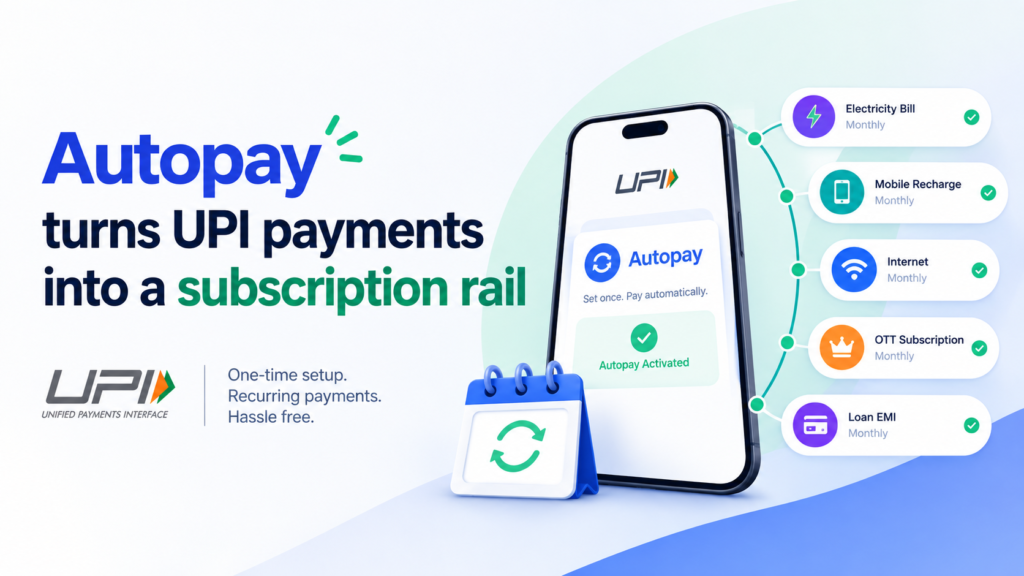
Most founders still file UPI under one-time checkout. That framing costs you revenue. UPI Autopay lets a customer approve a mandate once with their UPI PIN, after which you collect on schedule — daily through yearly — without touching card networks. Recurring UPI payments therefore skip the failure modes that card e-mandates introduce.
The adoption curve backs the bet. Reported NPCI figures show Autopay volume reaching 175 million in January 2025 against 58 million a year earlier, enough to pass card-based recurring payments. By November 2025, the top ten banks processed roughly 926 million Autopay transactions, up from 530.5 million the year before. SBI alone handled about 290 million that month.
Compare that with cards, where RBI’s 2021 e-mandate rules demand additional factor authentication above ₹5,000; Razorpay reports failure rates above 20% in some categories after that change. Involuntary churn of that size wrecks a Series A net-revenue-retention story. Recurring UPI payments dodge it inside these limits:
- ₹15,000 per debit for standard subscriptions and utilities, with no re-authentication
- ₹1 lakh for insurance premiums, mutual fund SIPs and credit card bills
- Authentication only at mandate creation, modification, or a debit above the category limit
- Reporting on the new framework indicates mandate and Autopay debits sit outside the prescribed MDR charge
Two operational catches. First, tag your mandate payload with the right merchant category code, or you push customers into needless PIN prompts and watch your success rate sag. Second, NPCI requires a pre-debit notification roughly 24 hours ahead, and circular OC-223 now lets customers view and cancel mandates from any UPI app. Treat that notification as a retention surface: send your own value reminder alongside it.
Ship it in one sprint, then instrument it
Three flows cover almost every product. Intent deep-links from your mobile app straight into the payer’s UPI app and converts best on phones. Collect pushes a request to a VPA the user types, which suits invoices and desktop checkout. QR handles in-person and screen-scan cases. A competent engineer wires intent plus a webhook listener through any aggregator in days, not weeks — the integration surface is genuinely smaller than a card gateway, because you skip 3-D Secure entirely.
Headroom rarely blocks you now. NPCI raised the per-transaction P2M ceiling to ₹5 lakh with a ₹10 lakh daily aggregate for specified categories including insurance, capital markets, travel, collections and GeM, while P2P stays at ₹1 lakh a day. High-ticket B2B invoices fit inside that envelope, so your sales team can stop wiring NEFT instructions into every contract and collect through UPI payments instead.
Then measure the thing properly. Log success rate per issuer bank, per PSP handle and per flow, because failures cluster by bank rather than spreading evenly — an aggregate number hides your actual problem. Build a retry path that switches handle or flow after a decline, keep one card fallback alive for the minority who want it, and avoid single-acquirer dependency. Also watch the clock on NPCI’s 30% market-share cap for any single UPI app: a forced redistribution of users across apps will move your per-app success rates, and teams that track UPI payments by app will spot the shift before their conversion charts do.
The rail already carries your customers, prices below your card costs, and now collects your subscriptions. Ship UPI payments as the default before 15 October, and let the finance team discover the savings on their own.Figures cited from NPCI data as reported in September 2026, including the MDR framework effective 15 October 2026. Verify current limits with your acquirer before launch.
Written By sumitmarketing.com