
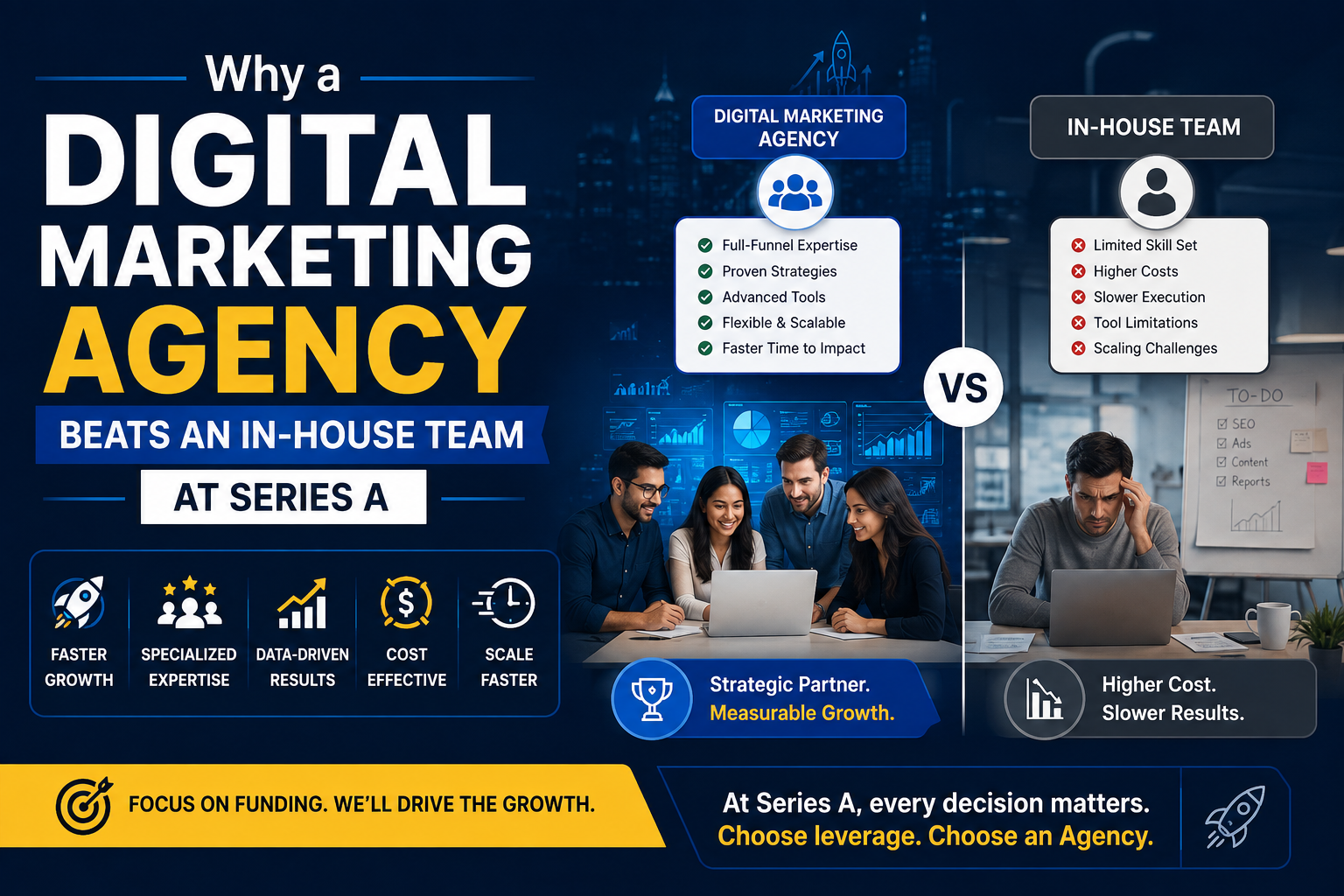
Your Series A round buys you eighteen months of runway, not eighteen months of trial and error on marketing hires, which is exactly why a digital marketing agency wins this stage. The Math Doesn’t Favor In-House Yet A single senior growth marketer costs $140,000 to $180,000 a year in most US markets, and that number covers one skill set, not the five you actually need: paid acquisition, SEO, content, lifecycle email, and analytics. A digital marketing agency bundles those five functions into one retainer, often for less than the fully-loaded cost of two in-house hires. Founders who try to build a complete team in-house at Series A end up with generalists stretched across channels they’ve never mastered, or specialists sitting idle between campaigns because the company doesn’t yet generate enough volume to keep them busy. A digital marketing agency solves this by pooling talent across clients, so you get a paid-search specialist for ten hours a week instead of paying a full salary for a skill you use in bursts. There’s also the hiring cost most founders underprice: recruiting a strong marketing lead takes eight to twelve weeks, and a bad hire costs another three months to detect and unwind. A digital marketing agency starts running campaigns within one to two weeks of signing, because the team, tooling, and processes already exist. At Series A, speed to first data point matters more than ownership of the function, and an agency compresses that timeline dramatically. Agencies Have Already Made the Mistakes You’re About to Make Every early-stage marketing hire learns which ad creative converts, which landing page kills conversion, and which channel wastes budget — by burning your money to find out. A digital marketing agency has run hundreds of similar campaigns across comparable company stages and buyer types, so it walks in with pattern recognition your first hire won’t have for a year. This shows up concretely: an agency can tell you within the first month that your CAC on paid social is structurally too high for a B2B SaaS product with a six-month sales cycle, because it has seen that exact mismatch dozens of times before. An in-house hire discovers the same thing after three months of spend. This experience compounds across channels. A digital marketing agency working across multiple clients spots shifts in platform algorithms, rising CPMs, or emerging channels faster than a single in-house marketer who only watches their own dashboards. When iOS privacy changes gutted Facebook attribution, agencies serving dozens of accounts adjusted their measurement approach within weeks; companies relying on one in-house marketer often took months to notice their numbers had gone stale. Founders Stay Focused on the Product, Not the Funnel Technical founders raise Series A to build product and close enterprise deals, not to learn the difference between a lookalike audience and a retargeting pool. Every hour a founder spends reviewing ad copy or debating attribution models is an hour not spent on the roadmap or the next round of customer interviews. A digital marketing agency takes that operational load off the founder’s desk entirely, delivering a weekly dashboard and a monthly strategy call instead of daily decisions that pull the founder out of deep work. This matters more than it sounds. Founders who try to manage marketing personally, or manage a junior in-house hire closely because they don’t trust the function yet, end up doing two jobs badly instead of one job well. A digital marketing agency comes with its own quality control, senior oversight, and reporting cadence, which means the founder reviews outcomes instead of managing inputs. That shift alone often recovers ten to fifteen hours a week for the founder, hours that translate directly into product velocity or sales pipeline. Scaling Down Is as Important as Scaling Up Series A companies pivot. A channel that works in month three can stop working in month nine because the ideal customer profile shifted, the sales motion changed, or a competitor entered the space. A digital marketing agency lets you reallocate budget across channels or scale spend up and down within a single billing cycle, because the retainer structure is built for that flexibility. An in-house team can’t be resized that quickly — laying off a marketing hire because a channel got cut is expensive, slow, and damaging to the culture you’re trying to build. This flexibility also applies to expertise. If your growth strategy shifts from paid acquisition to SEO and content because your CAC is climbing, a digital marketing agency reallocates specialists internally without you running a new search. A company relying on one in-house generalist has to either retrain that person from scratch or start a new hiring cycle, both of which cost months you don’t have between funding rounds. The agency model absorbs strategic pivots that would otherwise require a headcount change. Series A is a narrow window, and every month spent building a marketing function from scratch is a month a digital marketing agency could have spent generating pipeline. Hire the agency first, build the in-house team once the channels are proven and the budget justifies full-time ownership. Written By sumitmarketing.com
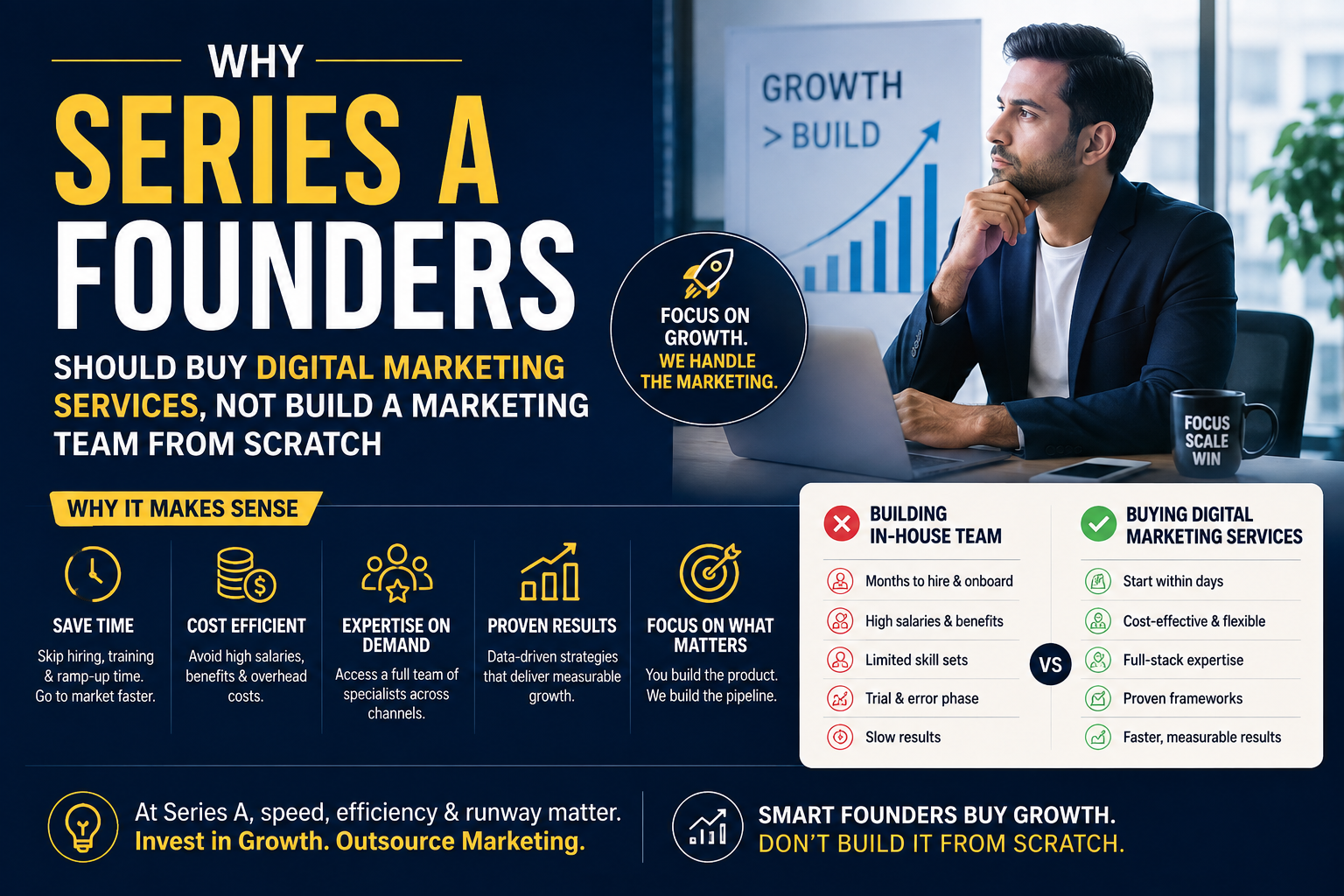
Why Series A Founders Should Buy Digital Marketing Services, Not Build a Marketing Team From Scratch
Your engineering team ships in two-week sprints, but your digital marketing services function is still stuck on a six-month hiring plan — and that mismatch is costing you pipeline. Most Series A companies treat growth marketing the way they treat infrastructure decisions from three years ago — build it internally, staff it slowly, and hope it scales. That instinct makes sense for your core product, where owning the stack is a genuine moat. It makes far less sense for the function responsible for filling your pipeline this quarter, where the fastest path to a working channel usually runs through an outside team rather than a new org chart. Compress Your Time-to-Signal At Series A, every quarter without a working growth channel is a quarter of runway spent on guesswork. Hiring a digital marketing services lead, a designer, a paid-media specialist, and an SEO contractor takes months of sourcing, interviewing, and onboarding before anyone touches a live campaign. Digital marketing services skip that queue. An established agency or fractional team already has the media buyers, copywriters, and analysts in place, so a campaign can go live in weeks instead of a quarter. This matters more for technical founders than the general SaaS playbook suggests. Your product cycles are fast, your ICP shifts as you learn from early customers, and your marketing needs to move at the same clock speed as your engineering roadmap. A strong external team is built around parallel execution — SEO, paid search, content, and lifecycle email running simultaneously — instead of the sequential build-then-launch pattern an in-house hire follows during their first ninety days. Speed to signal, not speed to headcount, is the metric that should drive this decision. There’s also an onboarding cost that rarely makes it into the hiring spreadsheet. A new internal hire needs weeks just to understand your product, your competitive set, and why your last three campaigns underperformed.digital marketing services An outside team that specializes in digital marketing services has already run that diagnostic playbook dozens of times, so the ramp from “start” to “first real data” is measured in days, not a full onboarding cycle. Convert Fixed Cost Into Variable Cost A single senior in-house digital marketing services hire at Series A typically costs well into six figures in salary, plus equity, benefits, and the recruiting overhead required to find them. That’s a fixed cost that shows up on your burn rate whether the channel works or not. Digital marketing services, by contrast, are structured as a retainer or performance-based engagement that you can scale up when a channel is producing pipeline and scale down when it isn’t. This flexibility protects your runway during the exact period when your CAC assumptions are least proven. You don’t yet know whether paid search, outbound, or content will be your primary engine — and locking in a full-time hire against one channel before you have that data is a bet most Series A boards won’t love. An external engagement lets you test three channels in parallel, kill the two that underperform, and reallocate budget without a layoff conversation. The team that builds your funnel can also disband parts of it the moment the data says to. Board conversations get easier with this structure too. Instead of defending a headcount line that may or may not pay for itself, you’re reporting on a line item tied directly to pipeline output, one you can resize each quarter based on results rather than a prior hiring decision. That kind of budget flexibility is hard to replicate once a full-time salary and equity grant are locked in, and it’s one of the clearest financial arguments for treating growth marketing as a service you buy rather than a department you build in year one. Bring Cross-Account Pattern Recognition An in-house hire, however talented, has visibility into one company’s data. An agency or specialist team running digital marketing services for a portfolio of B2B SaaS clients has seen what happens when a pricing page changes, when a paid campaign targets a narrow technical buyer, or when a content strategy shifts from top-of-funnel education to bottom-of-funnel comparison pages. That pattern library is the actual product you’re buying, not just the labor hours. For a technical founder, this is the equivalent of hiring a staff engineer who has already debugged your exact stack failure at three previous companies. You’re not paying for someone to learn on your dime. digital marketing services Providers of digital marketing services bring benchmarks — typical conversion rates by channel, realistic payback periods, warning signs that a campaign is about to plateau — that an internal hire usually can’t produce until they’ve run a full year of your own campaigns and gathered enough data to draw conclusions. This pattern recognition shows up in the small decisions that compound over a quarter: which subject lines get technical buyers to open an email, which ad formats a security-conscious ICP tends to ignore, which landing page structure holds attention for a developer audience versus a business-buyer audience. None of that is exotic knowledge, but it takes real repetitions to learn, and buying it from a team that already has the repetitions is faster than accumulating them yourself campaign by campaign. Free Founders to Own Strategy, Not Execution Many Series A founders end up as the de facto CMO by default, because there’s no one else in the building who understands positioning well enough to brief a designer or write ad copy that doesn’t sound like every other dev-tool landing page. That’s an expensive use of a founder’s time. A capable outside team absorbs the execution layer — campaign setup, creative production, reporting, channel optimization — so the founder’s job shrinks to reviewing results and setting direction, which is where a founder’s judgment actually adds value. This division of labor also produces better decisions. A founder reviewing a weekly report from a specialized team, armed with data from dozens of similar companies, makes sharper calls than a founder building campaigns themselves
Why SEO and Digital Marketing Decide Whether Your Series A Startup Compounds or Stalls
One well-ranked page can generate more qualified pipeline than three months of cold outbound, and that single fact should push every technical founder to treat SEO and digital marketing as an engineering problem rather than a marketing afterthought. SEO and Digital Marketing Compound While Paid Acquisition Decays Paid acquisition behaves like rent. You pay for a click, you get a visitor, and the moment you stop paying, the visitor stops arriving. SEO and digital marketing work the opposite way: you invest engineering and content effort once, and the resulting page keeps earning traffic for months or years. A founder who redirects even 20% of the paid budget toward SEO and digital marketing builds an asset that survives budget cuts, algorithm shifts in the ad auction, and CAC inflation that hits every category eventually. This matters most at Series A because runway math punishes anything that doesn’t compound. Your board wants to see CAC trending down and LTV:CAC trending up, and SEO and digital marketing move both numbers in your favor over a 12-to-18-month horizon. Paid search and paid social can move fast, but they rarely move your baseline. Organic search does. A developer tool company that ranks for “postgres connection pooling” or “webhook retry logic” captures buyers who are already mid-problem, not buyers who need to be interrupted with an ad. That difference in intent quality shows up directly in close rate, and close rate is the lever investors actually care about. Technical founders often assume SEO and digital marketing require a large content team. They don’t. They require a handful of pages that answer the exact questions your ideal customer types into a search bar right before they buy. Ten precise pages built around SEO and digital marketing fundamentals will outperform a hundred generic blog posts that nobody searches for. SEO and Digital Marketing Turn Product Data Into a Distribution Asset Most Series A companies sit on product data they never expose publicly: API documentation, benchmark results, integration guides, error message explanations, changelogs. Every one of these becomes a distribution channel when you apply SEO and digital marketing thinking to it. Documentation pages rank because they answer narrow, high-intent queries with precision that marketing copy can’t match, and developers trust documentation more than they trust a landing page. Stripe, Twilio, and Vercel didn’t win developer mindshare through display ads. They won it by making SEO and digital marketing part of the product surface itself: every error code, every API reference, every quickstart guide became a page that search engines could rank and developers could find. You don’t need their headcount to copy the strategy. You need someone on your team, technical or otherwise, who treats your public documentation as a growth channel and applies basic SEO and digital marketing structure to it, meaning clear headers, answered questions, and internal links that guide a reader from a narrow technical query toward your product. This is the fastest path to organic pipeline for a technical company, because the content already exists in your engineers’ heads. SEO and digital marketing, in this context, mostly means packaging knowledge you already have into a format search engines and humans can both parse. SEO and Digital Marketing Reduce Your Blended Cost of Acquisition Blended CAC is the metric that determines your next round’s valuation more than almost anything else, and SEO and digital marketing are the cheapest lever you have to bring that number down. A paid channel might cost you $150 per qualified lead indefinitely. An organic page, once it ranks, can produce leads at a marginal cost that approaches zero, because you already paid for the content creation and the ranking work up front. Run the math on your own funnel. Take your current paid CAC, then estimate how many organic visitors a ranking page in your category typically pulls per month, then divide your one-time production cost by twelve months of that traffic. In nearly every B2B SaaS category, SEO and digital marketing beat paid channels on cost within six to nine months, and the gap widens every month after that because the paid cost never drops while the organic page keeps earning. Investors who have sat through enough board meetings know the difference between a company that buys growth and a company that builds growth. SEO and digital marketing signal the second kind. When you can show a chart where organic traffic and organic-sourced pipeline both trend upward without a matching increase in ad spend, you’re telling your board a story about durable unit economics rather than a story about a leaky bucket you keep refilling. SEO and Digital Marketing Force Discipline That Improves the Whole Funnel The unexpected benefit of taking SEO and digital marketing seriously isn’t just traffic. It’s the discipline the process imposes on your positioning. To rank for a query, you have to answer it better than every competing page, and answering it better forces you to articulate your product’s value with a precision that vague marketing copy never demands. Founders who commit to SEO and digital marketing often discover their sales deck gets sharper as a side effect, because writing for search intent trains you to lead with the customer’s problem instead of your feature list. SEO and digital marketing also expose gaps in your funnel that nobody notices when leads come from warm intros or founder-led sales. When organic visitors land on a page and bounce, you see exactly where the story breaks. When they convert, you see exactly which argument worked. That feedback loop, driven by real search behavior instead of a survey or a sales call summary, gives you data your competitors won’t have unless they invest in SEO and digital marketing with the same rigor. Treat this as a system, not a project. Assign clear ownership, set a monthly cadence for publishing and updating pages, and track organic-sourced pipeline as its own line in your revenue dashboard next to paid and outbound. Companies that isolate SEO and digital marketing as “content

Digital Marketing Course Fee: What It Actually Buys You
A ₹40,000 digital marketing course fee and a ₹4,00,000 one can teach the exact same syllabus, and the price tag tells you almost nothing about which one gets your team results faster. The Real Range, Not the Marketing Number Digital marketing course fee in India spans a massive bracket: free certifications from Google and HubSpot Academy on one end, ₹5,00,000+ postgraduate and MBA-level specializations on the other. Most job-ready, placement-supported programs land between ₹40,000 and ₹1,00,000, covering SEO, paid ads, analytics, and increasingly AI-driven marketing tools. Digital Marketing Course Fee. MarOnline-only programs run cheaper, often ₹500 to ₹15,000 for pre-recorded content, while offline classroom training with live mentorship starts around ₹15,000 and climbs past ₹2,50,000 depending on the institute. For a Series A founder deciding whether to fund upskilling for a marketing hire, this spread matters more than any single number. A founder paying for a team member’s certification is not buying a credential — they’re buying whether that person can run a profitable ad account by month two. Digital Marketing Course fee.The fee itself is a weak signal. Curriculum depth, live project work, and placement or mentorship support are the variables that actually determine whether the spend converts into usable skill. Why Fee Alone Is a Bad Proxy for ROI Price and outcome do not move together in a straight line. A ₹12,000 course that skips Google Ads, live campaigns, and analytics tooling leaves a hire with theory and no execution ability. A ₹45,000 course built around real campaigns, current AI tools, and structured mentorship can produce someone who runs paid acquisition independently within weeks. The gap between these two isn’t fee — it’s whether the program forces hands-on work with a live budget instead of case studies. This is the same evaluation logic a founder applies to any vendor contract. Nobody signs a SaaS deal because the price sits in the “reasonable” bracket; they sign because the tool solves a specific, measurable problem faster than the alternative. A digital marketing course fee deserves the same scrutiny: does the program include live ad spend management, current-generation AI tools like GenAI content workflows, and a portfolio the learner can point to in an interview or on the job? If not, a lower fee is not a discount — it’s a smaller version of the same gap. Entry-level digital marketers in India typically start at ₹3–4.5 lakh per year, moving to ₹6–12 lakh with three to five years of experience, and reaching ₹15–25 lakh in senior roles. A well-chosen course in the ₹40,000–₹80,000 range pays for itself within the first two to three months of a hire’s salary — a payback period most founders would accept for any other operating expense. Where the Fee Goes and Where It Doesn’t A digital marketing course fee typically covers instruction, course materials, and — in the better programs — placement assistance or a portfolio review. It usually does not cover tool subscriptions. Budgeting an additional ₹5,000–₹15,000 annually for tools like SEMrush or Canva Pro, plus certification exam fees for platforms like Google Ads or Meta Blueprint, avoids a mid-program surprise. Institutes structure pricing around delivery mode and support depth, not raw content volume. Kraftshala’s program runs closer to ₹1,40,000 but ties a portion of that fee to a refund if the learner doesn’t get placed — a structure that puts real skin in the game on the institute’s side. Digital Vidya’s certification sits near ₹65,000 with placement support built in. Both cost more than a ₹10,000 self-paced course, and both justify that premium with accountability mechanisms the cheaper option doesn’t have. The practical takeaway for a founder evaluating this spend on behalf of a team: ask what happens if the hire doesn’t land results. Digital Marketing course fee. A course with a refund-linked outcome, live mentorship, or a placement guarantee shifts risk away from the company. A course that’s pure content shifts all the risk onto whoever paid the fee. How to Evaluate the Spend Like a Founder, Not a Student Treat a digital marketing course fee the way you’d treat any team investment with a measurable output. Founders who apply hiring-level scrutiny to a training budget consistently get better outcomes than those who pick based on price alone, because the fee was never the variable that determined the result. The Close The number on a digital marketing course fee tells you what you’ll pay, not what you’ll get back. Judge the program the way you’d judge any hire — by what it produces, not by what it costs. Written By sumitmarketing.com

Why Is 15 August Celebrated in India
Why Is 15 August Celebrated in India. A nation of over a billion people stops its factories, markets, and schools every year on the same date for one reason: freedom did not arrive by accident, and India refuses to let anyone forget it. The Historical Weight Behind the Date Why Is 15 August Celebrated in India. India won independence from British colonial rule on 15 August 1947, ending nearly two centuries of control that drained the subcontinent’s wealth and suppressed its self-governance. Lord Mountbatten, the last British Viceroy, picked this date to hand over power, and Jawaharlal Nehru delivered the “Tryst with Destiny” speech at midnight, marking the formal birth of a sovereign nation. This single event answers the question why is 15 August celebrated in India: it is the exact moment a colonized economy and population reclaimed control over their own decisions. For founders building anything long-term, this history offers a blunt lesson. Independence did not happen through a single dramatic act. It followed decades of organized, incremental pressure — boycotts, civil disobedience, legal challenges, and sustained public campaigns that compounded over time. The freedom movement operated like a distributed system with thousands of independent nodes (regional leaders, local committees, underground networks) all converging on one outcome. That structure, not any single leader, is why the effort survived setbacks that would have killed a centralized campaign. What the Day Actually Commemorates Why Is 15 August Celebrated in India.Independence Day is not a vague patriotic gesture. It marks three concrete transitions that reshaped the region permanently. Why Is 15 August Celebrated in India. Each year on 15 August, the Prime Minister hoists the national flag at the Red Fort in Delhi and delivers an address that reviews the country’s progress and sets priorities for the year ahead. State capitals, schools, and government offices repeat smaller versions of this ceremony nationwide. The consistency of this ritual, unbroken since 1947, is itself a data point: institutions that survive 75+ years of political turnover tend to have strong founding incentives baked in, not just sentiment. Why the Celebration Still Matters at Scale Skeptics sometimes ask why a founding event from 1947 deserves annual national attention when the country has moved on to different economic and technological priorities. Why Is 15 August Celebrated in India. The answer maps directly to how strong companies treat their own origin stories. Founding events set default behavior for everyone who comes after. India’s constitution, drafted in the years following independence, encoded universal adult suffrage, federal structure, and fundamental rights directly into law — decisions made by the founding generation that still govern how 1.4 billion people interact with their government today. A founder who documents company values on day one, rather than letting culture drift, is running the same playbook: encode the operating principles early, because retrofitting them later costs far more than getting them right at the start. Why Is 15 August Celebrated in India. There’s also a retention argument. National holidays that mark real historical stakes — not manufactured ones — sustain public engagement decade after decade because the underlying event carries weight people can verify and relate to. Independence Day draws consistent public participation not because of marketing but because the underlying event is real, costly, and permanent. Products and cultures that rely on manufactured urgency fade; ones built on a real, defensible origin compound. The Practical Legacy Founders Can Actually Use Three concrete takeaways translate directly from 15 August 1947 into operating decisions for a growing company. Decentralized effort beats centralized heroics. Why Is 15 August Celebrated in India. The independence movement succeeded through parallel, distributed campaigns rather than one command center. Teams that push decision-making down to people close to the problem move faster and survive leadership changes better than teams that route everything through a single founder. Transition planning determines the outcome, not the announcement. The handover of power in 1947 was messy, rushed, and cost lives during Partition — proof that timing and execution matter more than the symbolic moment itself.Why Is 15 August Celebrated in India. Any founder planning a leadership transition, an acquisition, or a market exit should treat execution planning as the real work, not the announcement. Founding documents outlast founding people. India’s constitution has been amended over 100 times but has never been replaced, because its core structure was sound. A company’s founding documents — cap table terms, governance structure, IP assignments — deserve the same rigor, since founders will eventually leave the room but the paperwork keeps operating. India’s GDP has grown from roughly $30 billion at independence to well over $3.5 trillion today, illustrating how sustained institutional continuity, not any single policy, compounds over decades. That’s the real ROI case for treating founding moments seriously instead of glossing over them once a company scales past its first product. The Close Why Is 15 August Celebrated in India. Fifteenth August marks the day a nation stopped asking permission and started building on its own terms. Anyone scaling a company faces the same choice, every single day, on a much smaller stage. Written By sumitmarketing.com

Why “Food Delivery Near Me” Is the Highest-ROI Keyword Your Product Team Is Ignoring
A founder who ranks for “food delivery near me” captures a customer who already decided to buy, not one who still needs convincing. The Search Intent Behind “Food Delivery Near Me” Is Already Bottom-of-Funnel Someone typing “food delivery near me” holds a phone, feels hungry, and wants an answer in the next ten seconds. This person doesn’t compare brand philosophies or read blog posts about cuisine trends. They tap the first result that looks fast and local. For a Series A team burning cash on paid acquisition, this matters: a query with this level of intent converts at a rate that generic terms like “best restaurants” never approach. Your engineering team can build the fastest checkout flow in the category, but if the app never surfaces for “food delivery near me,” none of that speed reaches the customer. Google and Apple Maps both treat this phrase as a local-pack trigger, which means ranking for it puts your app in front of a person who searches, taps, and orders within the same session. That session-to-order window is the shortest path to revenue your team will find anywhere in the funnel. Local Relevance Beats Brand Recognition for This Query Founders coming from B2B SaaS backgrounds often assume brand equity drives conversion. Food delivery near me breaks that assumption. A hungry user near a coffee shop in Austin doesn’t care that a competitor raised a bigger Series B; they care whether your app shows a driver eleven minutes away instead of thirty-one. This is a proximity game, not a brand game. Product teams that treat “food delivery near me” as a ranking and matching problem, rather than a marketing slogan, win the order. That means your engineering roadmap needs three things working together: an accurate real-time location index, a restaurant inventory synced within minutes rather than hours, and a search result page that answers the query with distance and delivery time up front. Skip any one of these, and the app loses the moment the query represents, no matter how strong the brand deck looks to investors. Real Examples Show the Pattern Across Markets DoorDash built its early growth around dense, hyperlocal coverage in suburban markets that larger competitors ignored, and that density is exactly what “food delivery near me” rewards: a search engine surfaces the option with the most relevant nearby inventory, not the option with the most funding. Uber Eats took a different route, layering its delivery product onto an existing rideshare network already indexed for location-based queries, which gave it a head start on local search visibility before it wrote a single line of delivery-specific code. Smaller regional players like ChowNow have carved out defensible niches by optimizing exclusively for local restaurant partnerships rather than chasing national scale, and they still show up reliably for food delivery near me searches in their specific metro areas. The pattern across all three companies holds steady: whoever answers the local query fastest and most accurately captures the session, regardless of total funding raised or headcount size. The ROI Math Favors Local Search Over Broad-Match Paid Acquisition A Series A team watching burn rate needs to know where a dollar returns the most revenue, and food delivery near me consistently outperforms broad-match paid campaigns on cost per acquisition. Broad-match terms pull in browsers, students researching a class project, and competitors’ customers who never intended to switch apps. Food delivery near me pulls in someone who wants to order within minutes. Your CAC on the local-intent query drops because the click already carries purchase intent baked in; you’re not paying to educate the user, you’re paying to be visible at the exact moment they decide. This also compounds over time: every completed order from a food delivery near me search builds review volume and local ranking signals that improve organic visibility for the next search in that same neighborhood, which lowers paid spend in that zip code over subsequent months. Founders who track cohort LTV by acquisition channel typically find that local-search-driven users retain better too, because the app solved a real, immediate problem rather than winning a click through a discount code. Build for the person who searches food delivery near me and means it right now, and the revenue follows without a single generic CTA. Speed to answer beats size of budget every time this query fires. Written By sumitmarketing,com

The Jantar Mantar Protest Is a Better Growth Playbook Than Most Series A Marketing Decks
A hundred people with placards outside a government building in Delhi generate more national attention in a single afternoon than most Series A startups generate in a full quarter of paid campaigns, and the mechanism behind that gap is worth stealing. Why the Jantar Mantar Protest Outperforms Paid Distribution Jantar Mantar sits a few hundred meters from Parliament House in New Delhi, and Indian authorities designated it decades ago as the sanctioned site for public demonstrations. That single fact changes the economics of every Jantar Mantar protest. Organizers do not need to buy proximity to power — they inherit it. A founder trying to get a product in front of decision-makers usually pays for that proximity through ads, conferences, or cold outreach. A Jantar Mantar protest gets it for the cost of a permit and a few banners. Compare the unit economics. A moderately sized Jantar Mantar protest with a few hundred participants and a clear, quotable demand routinely earns coverage across national television, wire services, and dozens of regional papers within 24 hours. Founders spend five- and six-figure sums on PR retainers chasing that same reach and often land a single mention buried in a roundup. The protest converts physical presence at a fixed, symbolically loaded location into media attention. Founders convert dollars into media attention. One of these channels has a materially lower cost per impression, and it is not the one venture-backed companies default to. The Concentration Principle Behind Every Jantar Mantar Protest Every effective Jantar Mantar protest works because it concentrates a diffuse grievance into one place, one time, and one visual. Diffuse pressure does not move institutions. Concentrated pressure does. Organizers who bring 5,000 supporters from across India to one 200-meter stretch of road on one specific day are not maximizing total reach — they are maximizing density at the exact coordinates where journalists, cameras, and officials already look. Founders scatter their equivalent of that pressure across a dozen weak channels: a LinkedIn post here, a newsletter mention there, a conference booth next month. None of it concentrates. A Series A team preparing a launch, a funding announcement, or a policy pushback against a regulator gets more traction by picking one moment and one channel and pouring every resource into it than by spreading the same budget thin across many. The Jantar Mantar protest never happens at three locations on three different days — it happens once, at full intensity, where it counts. Founders who split a launch across staggered drips instead of one coordinated push are working against the same principle the protest organizers exploit. What the Jantar Mantar Protest Teaches About Signal Design A Jantar Mantar protest lives or dies on its signal, not its size. The protests that dominate headlines are the ones with a single sharp, repeatable demand — a specific bill, a specific resignation, a specific number — not the ones with the largest crowd but the vaguest message. Journalists need one sentence they can put in a headline. Officials need one demand they can respond to or reject. A blurry ask, however large the crowd behind it, gets far less coverage than a sharp one backed by fifty people. This is the same discipline behind a strong Series A pitch or launch narrative. Investors and press do not remember “we’re building infrastructure for the future of X.” They remember one claim they can repeat to someone else. Founders who show up to a Jantar Mantar-style moment — a launch, a funding round, a public stand on a regulatory fight — with a fuzzy multi-point message dilute the exact attention they worked to concentrate. The organizers of any effective Jantar Mantar protest write their one-line demand before they write anything else. Founders should treat their core claim the same way: draft it first, and build every asset around defending that one line. Sharp messaging also explains why coalitions outperform solo efforts at Jantar Mantar. A single-issue protest with one organizer rarely reaches critical mass, but the protests that shut down news cycles are almost always coalitions — multiple unions or advocacy groups that each bring their own members and press contacts, then combine under one banner and one demand. The organizing group does not need to fund the entire turnout; it needs partners who already have turnout and align them around a shared moment. A founder can copy this directly: partnering with a few adjacent companies or influential customers who already have committed audiences, then aligning one coordinated launch moment across all of them, produces the same multiplier a coalition brings to a Jantar Mantar protest, at the cost of coordination time rather than acquisition spend. Timing reinforces this concentration. Every Jantar Mantar protest that lands in the national news cycle is scheduled against something specific — a parliamentary session, a court ruling, a policy deadline — rather than picked at random and hoped for. Organizers anchor the protest to a date that already has institutional attention pointed at it, then position their message to intersect that attention at the exact moment it peaks. Founders routinely skip this step and ship announcements on their own internal calendar instead of the market’s calendar. A funding round announced the same week as a major industry conference, or a launch timed against a competitor’s earnings call, borrows attention that already exists rather than trying to generate it from zero — the same trick that lets a Jantar Mantar protest ride a news cycle instead of competing against one. The Real ROI Lesson From the Jantar Mantar Protest The clearest lesson a technical founder can take from the Jantar Mantar protest is that leverage beats budget. Organizers cannot outspend a government or a corporation, so they exploit a structural advantage instead: a location that guarantees media presence, a moment that guarantees institutional attention, and a message sharp enough to survive translation into a headline. None of that costs venture-scale money. It costs planning discipline. Series A founders sitting on six or seven figures
Your Engineers Should Not Be Running Your Google Ads
You raised a Series A to build product — and right now, your best engineers are debugging UTM parameters instead of shipping features, because you haven’t hired a digital marketing agency yet. Why In-House Marketing Burns Your Runway Faster Than You Think Technical founders default to building everything in-house. It works for product. It destroys you in marketing. Here’s the math. A senior growth marketer in a major US metro costs $130,000–$160,000 base salary in 2024, plus equity, benefits, and three to four months of ramp time before they produce anything measurable. A mid-tier digital marketing agency retainer runs $5,000–$15,000 per month and activates within two weeks, bringing a team that already has paid media specialists, SEO strategists, conversion rate optimizers, and copywriters under one roof. Figma’s early growth team leaned heavily on agency support before scaling in-house — not because they lacked talent, but because agencies deploy faster. At Series A, speed is the only advantage you have over better-funded competitors. A digital marketing agency gives you a full growth function in week three. A single hire gives you one generalist still learning your product in month four. Beyond cost, there’s capability breadth. A paid acquisition specialist who has run campaigns for 40 B2B SaaS companies recognizes your specific losing pattern — high CTR, low conversion, wrong ICP targeting — in day one. Your first in-house hire figures that out in month six. That gap costs pipeline. The argument against agencies — “they don’t know our product” — is a training problem, not a structural one. You solve it with a rigorous onboarding doc and a weekly 30-minute sync. You do not solve slow agency speed with a full-time hire who takes equity and a benefits package. What a Digital Marketing Agency Actually Delivers (And What It Doesn’t) Stop evaluating agencies on deliverables. Evaluate them on feedback loops. The right digital marketing agency runs structured experiments with defined success metrics before spending your budget at scale. They ship a creative test with five ad variants in week one, kill three by week two, and double down on the two that hit a sub-$40 cost-per-lead by week three. That cycle — hypothesis, test, kill, scale — compounds faster than any single hire can manage alone. Concrete deliverables from a performance-focused digital marketing agency in months one through three should include: a full-funnel audit of your existing traffic and conversion data, a paid media playbook specific to your ICP, three to five landing page variants with A/B test results, and a baseline attribution model that connects top-of-funnel spend to closed revenue. If an agency cannot show you those outputs in the first 90 days, fire them. What agencies will not do well: product-level content that requires deep technical knowledge, community building that demands authentic founder voice, and analyst relations that hinge on personal credibility. A digital marketing agency amplifies distribution. It does not manufacture brand trust. That part is still your job. Drift, before its acquisition by Salesloft, used agency support specifically for paid acquisition and SEO while keeping thought leadership content internal. That division of labor let their team publish founder-level insights while the agency scaled the reach. The result was a brand that felt both authoritative and discoverable — a combination that neither side could have produced alone. How to Evaluate a Digital Marketing Agency Without Wasting Three Months Most agency selection processes are backwards. Founders ask for case studies, get impressed by logo slides, sign a six-month contract, and discover the bad fit in month two. Run this filter instead. Ask every digital marketing agency candidate three questions before you review a single portfolio piece: One: What is your process when a campaign underperforms in the first 30 days? Good agencies describe a kill-and-pivot framework with specific decision thresholds — “if cost-per-acquisition exceeds $X by day 21, we reallocate budget to the next hypothesis.” Bad agencies say “we optimize continuously,” which means nothing. Two: Who actually works on our account? Many large digital marketing agency firms sell you on senior leadership, then hand you to a junior analyst. Demand the names and LinkedIn profiles of the three people who will touch your campaigns daily. Verify their experience matches your channel mix. Three: Can you show us a campaign that failed and what you learned from it? Agencies that share failures have a genuine testing culture. Agencies that only share wins are selling you a highlight reel. You want a partner who treats a $3,000 failed experiment as data, not as something to hide. Proof of fit also comes from vertical specificity. A digital marketing agency that has worked with three to five B2B SaaS companies at your stage understands that your sales cycle is 45–90 days, that your buyer reads G2 before they read your website, and that LinkedIn outperforms Meta for your ICP. An agency with a generalist client roster will learn all of that on your dime. Negotiate milestone-based contracts with a 30-day exit clause in the first 90 days. No credible digital marketing agency will refuse that term if they believe in their own performance. The ROI Benchmarks That Should Drive Your Decision Numbers you can hold agencies accountable to — sourced from HubSpot’s 2024 State of Marketing Report and Databox benchmark data. B2B SaaS companies spending $15,000–$30,000 per month on managed paid media through a specialized digital marketing agency report a median pipeline-to-spend ratio of 6:1 in months four through six, once campaigns have sufficient optimization data. Below a 4:1 ratio after month five, you either have a channel fit problem or an agency performance problem — both require immediate action. SEO-focused digital marketing agency engagements produce slower but more durable returns. Organic traffic from a well-executed content and technical SEO program begins compounding at month four and typically reaches positive ROI by month nine. If your sales cycle exceeds 60 days, organic content is not slow — it’s aligned to your buyer’s research timeline. For conversion rate optimization, a competent digital marketing

Why Searching “Website Designer Near Me” Still Wins for Series A Companies Moving Fast
Your VP of Marketing just told you the site converts at 1.2%—half the industry benchmark—and your next funding milestone depends on fixing it in six weeks. The Local Advantage Is a Speed Multiplier, Not a Comfort Preference Most technical founders dismiss the search query website designer near me as something small-business owners type when they want someone to bring a laptop to a coffee shop. That assumption is costing real companies real quarters. A website designer near me operates inside your timezone, attends your sprint reviews without scheduling a 6 AM or 11 PM call, and can walk into your office when the rebrand brief needs a whiteboard, not a Loom video. Tighter feedback loops compress delivery cycles. When Lattice needed a rapid overhaul of its product marketing pages ahead of a Series B announcement, the team leaned on a designer embedded in San Francisco who could participate in morning standups and ship changes before EOD. No async lag. No version-mismatch nightmares between a 9 AM Figma comment and a 2 AM response. For founders who measure iteration speed in days, not sprints, that proximity is compounding ROI. Every round-trip communication you eliminate from the design-to-dev handoff is two to four hours recovered. Across a six-week engagement, that math adds up to roughly a full workweek of reclaimed execution time. What a Local Website Designer Near Me Actually Delivers That Offshore Doesn’t The case against offshore design is not about quality—it’s about context. A website designer near me understands your specific market’s visual language, regulatory defaults (WCAG compliance expectations vary by region and industry), and the competitive positioning cues your ICP reads instantly. Concrete differences that show up in audits: Conversion-optimized copy placement. A designer who has watched your sales team pitch at a local demo day knows where technical buyers look first on a B2B landing page. That knowledge doesn’t transfer cleanly through a 10-page brief. Brand consistency across offline and digital. Series A companies still do events, sales decks, and printed pitch materials. A local website designer near me attends the same industry meetups your prospects do. They know when a color palette reads as legacy fintech versus emerging infrastructure play. Speed on compliance edge cases. CCPA, ADA Title III, and state-specific data disclosure requirements change. A designer based in your jurisdiction tracks those updates through local networks and trade groups, not through a ticket you have to file. Dribbble scores don’t capture any of this. A portfolio review tells you what someone can build. Proximity tells you how fast they can build it under real operational pressure. How to Evaluate a Website Designer Near Me Without Wasting Three Weeks Technical founders over-index on portfolios and under-index on process. Run this four-question filter before you pay a retainer: 1. Show me a project where the first design direction failed. Any designer who claims linear success on every project is either inexperienced or dishonest. You need someone who debugs design the way you debug code—with hypotheses, tests, and documented reversals. 2. What’s your handoff format, and what do you deliver to developers? The answer should include Figma component libraries, documented design tokens, and a named developer they’ve shipped with before. “I send over the files” is a red flag. 3. How do you handle scope changes at week four? Series A product roadmaps shift. Your website designer near me needs a stated change-management process, not improvised renegotiation mid-sprint. 4. What metrics did your last client move? If they can’t name a before-and-after number—bounce rate, conversion rate, session duration, lead form completion—they haven’t worked with teams who treat the website as a growth lever. Local agencies and independent website designer near me professionals who pass this filter exist in every major metro. In New York, Chicago, Austin, and the Bay Area, you’ll find designers with SaaS-specific portfolios who have shipped for companies at exactly your stage. Search with specificity: “Series A SaaS website designer near me” or “B2B conversion designer [your city]” returns meaningfully different results than a generic query. Build the Brief Before You Sign Anything The fastest project failures share one cause: the founder treated the design engagement as a vendor relationship instead of a product sprint. Treat your website designer near me the way you treat an embedded contractor. Ship them a brief that contains: A website designer near me who receives this brief on day one ships measurable work in week three. A designer who spends week one extracting this information from three different stakeholders ships at week six—after you’ve already missed your milestone. Stop treating your website as a branding cost and start treating it as a pipeline variable—then find a website designer near me who reads their metrics the same way you read yours. The right local designer won’t just build you something beautiful; they’ll ship something that moves the number you care about, on a timeline your runway can afford. Written By sumitmarketing.com

Your Web Design Is Losing You Deals Before Your Sales Team Gets Involved
Web Design Investors funded your product, not your homepage — but your homepage is the first thing a prospect, enterprise buyer, or potential hire sees, and bad kills deals that your team never even knows existed. Web Design Directly Impacts Pipeline, Not Just Perception Stop treating as a branding exercise. It is a revenue function. Forrester Research found that every $1 invested in UX returns $100 on average — a 9,900% ROI. That number feels extreme until you walk through the math at your stage. You close a $50K ARR deal. Web Design Your site conversion rate is 2%. If improved lifts that to 3%, you add 50% more pipeline from the same ad spend, the same SEO, the same content. You pay your sales team nothing extra. Stripe’s original B2B set the benchmark for developer-focused companies. Their documentation pages, their pricing layout, their API reference — all of it was product-quality web design deployed as marketing. The result? Developers trusted them before making a single API call. built conviction faster than any sales deck. At Series A, you compete against companies with larger teams and bigger budgets. is one of the few levers that punches above your weight class. A $40K investment in web design improvements outperforms $200K in incremental paid acquisition if your existing traffic converts at 1% instead of 3%. The Three Web Design Mistakes That Kill Enterprise Deals Enterprise buyers behave differently from SMB buyers. They screenshot your pricing page, send it to legal, and forward your homepage to a VP before your AE sends a follow-up. Your web design communicates credibility — or destroys it — in seconds. Mistake one: generic SaaS templates. If your site uses a Webflow template that 4,000 other companies also purchased, procurement teams notice.that looks identical to your competitor signals low differentiation at the product level, even when your product is genuinely better. Figma built their entire brand on distinctive web design. Their site looked and felt like a design tool, not a marketing site — that coherence was itself proof of product quality. Mistake two: navigation that assumes familiarity. Your prospects do not know your product taxonomy. If your buries the use case most relevant to an enterprise buyer behind three clicks, they leave. Gong redesigned their navigation architecture in 2021 to lead with outcomes (“more revenue,” “fewer deal risks”) rather than features. Inbound enterprise inquiries increased measurably. Navigation. Information architecture. Mistake three: mobile web design treated as an afterthought. Your ICP is a VP at a mid-market company. They open your site on their phone during a commute. If your breaks below 768px, you lost them before your SDR sent the outreach. Google’s Core Web Vitals directly affect your search ranking, and 70% of those signals come from mobile web performance. Poor mobile costs you both deals and organic traffic simultaneously. What Good Web Design Actually Costs at Series A Budget clarity matters, so here is a realistic framework. A full engagement with a strong agency — strategy, UX, visual design, development — runs $80K–$200K and takes 12–20 weeks. That investment makes sense if you have established messaging, a defined ICP, and existing traffic above 20K monthly visitors. The ROI calculation is straightforward: if your average contract value is $30K and you close 10 more deals per year from improved conversion, you generated $300K in new ARR from a one-time investment. For founders who need results faster, a targeted sprint costs $15K–$40K and focuses on three high-leverage pages: homepage, pricing, and one key solution page. Basecamp’s Jason Fried built a framework for this approach — fix the pages that receive the most traffic and have the clearest conversion intent first. This approach delivers measurable results in 6–8 weeks. In-house works when you have a product designer who also understands marketing psychology. Most Series A companies do not. Forcing your product designer to own optimization splits their focus and produces mediocre results in both areas. Hire a contract specialist or engage an agency for the marketing site. Keep your product designer focused on the product. One number to benchmark your current web design performance: if your homepage-to-trial conversion rate falls below 2%, your web design has a quantifiable problem. HubSpot’s data across 100,000+ company websites shows that top-quartile B2B SaaS sites convert homepage visitors at 3.5–5%. That gap represents recoverable pipeline. Web Design Decisions That Compound Over Time Web design is not a one-time project — it is a system that either compounds or decays. The companies that win on web design establish a design system early. Vercel, Linear, and Notion all built internal component libraries that made web design iteration fast. Every new landing page, every campaign microsite, every product update page got deployed in days instead of weeks because the web design foundation was solid. They shipped faster than competitors and maintained visual coherence at scale. The inverse happens too. Technical founders defer web design investment, accumulate design debt, and end up with a Frankenstein site — three different navigation patterns, four different button styles, inconsistent typography across pages added by three different contractors. Cleaning that up costs more than building a system correctly the first time. Treat your web design as infrastructure. Establish a design system with documented components, tokens, and usage guidelines. Require new pages to use that system. Review web design quality quarterly the same way you review engineering code quality. Web design debt compounds exactly like technical debt. Personalization represents the next frontier in web design ROI. Companies like Mutiny and Intellimize allow B2B SaaS companies to serve different web design experiences to different segments — enterprise visitors see enterprise-specific social proof, SMB visitors see different pricing signals. Carta and Segment used this approach to increase demo request rates by 30–60% without changing a line of their core web design. Dynamic based on firmographic data is table stakes for Series A companies competing for enterprise contracts. Web design is not a cost center — it is a conversion machine running 24 hours