

Most Series A founders treat Social Security tax as a solved problem the moment they sign up for Gusto or Rippling, but the IRS holds the company, not the software, liable when the numbers are wrong.Founders scale fast by hiring contractors first and converting them to employees later, or never. That instinct saves cash in month one and creates a Social Security exposure that compounds with every payroll cycle. When the IRS or a state agency reclassifies a contractor as an employee, the company owes the employer share of Social Security and Medicare tax retroactively, plus the employee share the company failed to withhold, plus penalties and interest layered on top. Section 3509 of the tax code sets reduced rates for unintentional misclassification, but “unintentional” still requires the company to prove it had a reasonable basis for the contractor classification — something most fast-moving startups never documented.
The Misclassification Trap Costs More Than the Tax Itself
Founders scale fast by hiring contractors first and converting them to employees later, or never. That instinct saves cash in month one and creates a Social Security exposure that compounds with every payroll cycle. When the IRS or a state agency reclassifies a contractor as an employee, the company owes the employer share of Social Security and Medicare tax retroactively, plus the employee share the company failed to withhold, plus penalties and interest layered on top. Section 3509 of the tax code sets reduced rates for unintentional misclassification, but “unintentional” still requires the company to prove it had a reasonable basis for the contractor classification — something most fast-moving startups never documented.
The practical trigger isn’t a random audit. It’s usually a departing contractor filing for unemployment, a workers’ comp claim, or a state Department of Labor referral that cascades into a federal review. A technical co-founder who classified early engineers as 1099 contractors to avoid running payroll in year one can find that decision surfacing eighteen months later during Series B diligence, when a buy-side accountant flags unfunded payroll tax liability on the balance sheet. That liability follows the entity, not the individual who made the call, and it shows up as a valuation adjustment or an indemnification clause that slows the round.
The Wage Base Cap Changes Your Math Every January
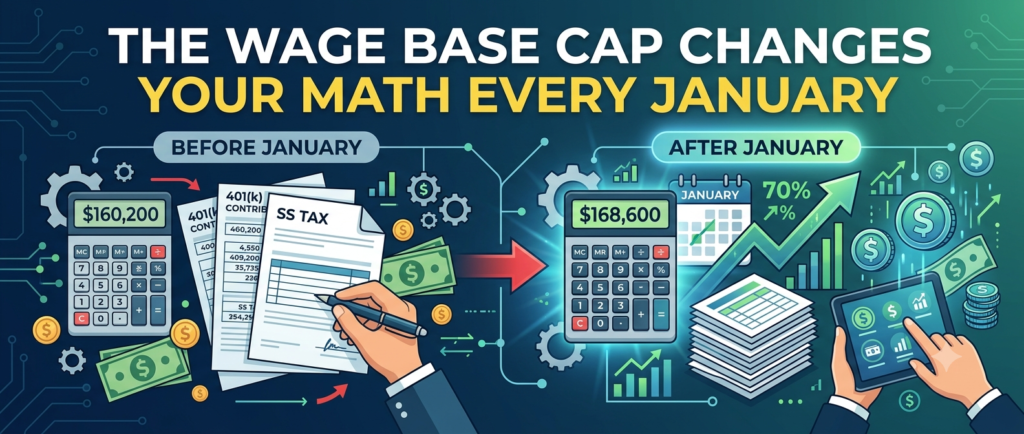
Social Security tax applies only up to an annual wage base — $176,100 for 2025, moving to $184,500 for 2026 — after which the 6.2% employer and employee shares stop applying, though the 1.45% Medicare tax keeps going with no cap. Founders who front-load compensation, run bonus cycles at year-end, or restructure comp after a fundraise often mistime this. Paying a senior engineer a large bonus in December instead of January means the company eats employer-side Social Security tax on dollars that would have been exempt had the payment landed after the employee crossed the wage base earlier in a new cycle, or vice versa depending on where they sit relative to the cap.
This matters more than it looks because payroll platforms calculate the cap per employer per year, not per employee across jobs. An employee who left another company mid-year and already hit the wage base there gets no credit at your company — you withhold as if starting from zero, and the employee reconciles the overpayment on their personal return the following April. That’s not a bug, it’s correct by design, but it means your effective payroll tax cost as a percentage of a senior hire’s total comp is higher in year one than the steady-state number a finance model usually assumes. Startups modeling burn off a flat “employer payroll tax rate” without adjusting for new hires crossing the cap late in the year routinely understate near-term cash burn by a measurable margin on every senior hire made after October.
S-Corp Elections Change What Founders Personally Owe
Once a founder takes a salary through an S-corp instead of drawing pure distributions, Social Security tax enters the founder’s own compensation decision, not just the company’s payroll line. The IRS requires S-corp owner-employees to pay themselves “reasonable compensation” subject to FICA before taking additional profit as distributions that avoid the 15.3% combined self-employment tax. Founders who set their own salary artificially low to minimize this tax create exactly the audit flag the IRS built the reasonable-compensation rule to catch, and Revenue Ruling 74-44 gives the IRS explicit authority to reclassify distributions as wages and assess the shortfall plus penalties.
The founders who get this right treat their own salary as a benchmarking exercise, pulling comparable comp data for their role, stage, and geography the same way they’d benchmark an executive hire, and documenting the reasoning in board minutes. The founders who get it wrong tend to discover the problem during due diligence for a priced round, when counsel reviewing cap table and comp history asks why the CEO’s W-2 wages sat at $40,000 for two years while the company distributed six figures in profit. That’s a fixable problem months before a raise. It’s a much harder conversation during the raise itself.
Multi-State Remote Teams Multiply the Exposure

A distributed engineering team means the company runs payroll tax obligations in every state where an employee physically works, and while Social Security itself is federal and uniform, the state-level unemployment insurance and disability tax systems that ride alongside it are not. Hiring a remote engineer in a state where the company has no existing payroll registration triggers a nexus event: the company now owes state unemployment tax registration, potentially state disability insurance withholding, and in some states, a retroactive look-back if the hire has been working for months before HR catches the address change. California, New York, and New Jersey are the three states most likely to send an inquiry letter within a year of an unregistered remote hire starting work, because their agencies cross-reference federal W-2 filings against state registration databases.
The fix costs almost nothing if done at hire — most payroll platforms support state registration as a checkbox during onboarding. The fix costs real money if done reactively, because retroactive registration typically triggers a review of every prior pay period in that state, and Social Security withholding errors found during that review get bundled into the same penalty assessment even though Social Security itself never changed. Founders who treat “where do our employees actually live” as a quarterly HR question rather than a payroll compliance question are the ones who get the surprise letter.
The Fix Is Cheaper Than the Cleanup
None of these four exposures require a compliance department to manage — they require a founder who treats payroll tax classification, wage base timing, reasonable compensation, and multi-state registration as diligence items reviewed quarterly, not annually. The companies that get burned aren’t the ones with complex Social Security tax situations; they’re the ones who assumed the payroll platform was handling a decision that only the founder was positioned to make.
Written By sumitmarketing.com