

Start with the work that follows a script: rotoscoping, de-aging, voice matching, and background generation. These movie roles turn a clear brief into finished pixels and audio, and AI now handles large parts of that translation. Two traits mark the work that compresses first: a specification exists before the work starts, and someone can verify the result in minutes.
Everything Everywhere All at Once shows the pattern. The film won Best Picture at the 2023 Oscars, and its small VFX team used Runway’s AI tools for parts of its rotoscoping work, the frame-by-frame cutouts that traditionally demand painstaking manual effort.
Netflix pushed further. In July 2025, co-CEO Ted Sarandos said the Argentine series El Eternauta used generative AI for a building-collapse scene, and that the team finished the sequence about ten times faster than traditional VFX tools would have allowed. Lucasfilm took a third route on Obi-Wan Kenobi: it used Respeecher’s voice technology to recreate a younger Darth Vader voice after James Earl Jones approved the use of his archive.
Each example targets a task with a defined input and a checkable output. Software teams know that profile well: boilerplate code, test scaffolding, support triage, and documentation drafts. Your startup’s version of these movie roles lives in the same category, and the same speed gain applies.
That gain matters at Series A because runway depends on how many shipped features each salary buys. When an execution task drops from days to hours, you either ship sooner or hire later, and both outcomes extend your runway. Sarandos reported that ten-times figure himself, so treat it as a company claim and measure your own results before you build a plan around it.
Judgment-heavy movie roles gain leverage
Directors, editors, producers, and cinematographers decide what an audience feels. AI does not supply that decision. It multiplies the number of options each of these movie roles can test before committing budget.
Lionsgate signed a partnership with Runway in September 2024 to build a custom model on its own film and TV library, giving its filmmakers tools for pre-visualization and post-production. The logic follows directly. When a director can preview ten versions of a shot for the price of one, the scarce resource shifts from production capacity to taste. Someone still has to pick the take that works, and that person carries the accountability. The best editors already work this way: they compare cuts and choose. AI adds more cuts to compare.
Founders face the same shift. When code, copy, and mockups get cheap to generate, your bottleneck becomes the person who knows which version to ship. Staff engineers, product leads, and senior designers hold the judgment-heavy movie roles in a startup. A staff engineer who compares five AI-drafted implementations in an hour raises the odds of choosing the right architecture, because the comparison itself now costs little.
This changes your hiring plan. Hire fewer people whose value lies in typing out well-specified work. Hire more people who write the spec, review the output, and own the result. Judgment-heavy movie roles cost more per head, but each head directs more output, and that trade favors a team that needs speed without a large payroll.
Track cost per iteration, not cost per output. Film crews already do: a reshoot costs far more than a second edit, so directors test ideas where changes stay cheap. Promote your best reviewers first, because the engineer who catches a flawed AI-generated design before release protects every sprint that builds on it.
Contracts now define movie roles as much as job titles
Hollywood’s 2023 strikes wrote AI rules into the work itself. The WGA agreement says AI cannot write or rewrite literary material, and a company cannot require a writer to use AI software. SAG-AFTRA’s contract, which arrived after a 118-day strike that ended on November 9, 2023, requires consent and compensation for digital replicas of performers. These clauses define movie roles through permission, not only through skill, and they protect the most human-facing movie roles: writer and performer.
Scrutiny keeps growing outside the union table. In June 2025, Disney and Universal sued Midjourney for copyright infringement over its image generator. In September 2025, SAG-AFTRA publicly condemned Tilly Norwood, a synthetic performer, and argued it draws on the work of countless human actors. Both cases show that consent and ownership now draw legal and public attention.
Founders can borrow the structure. Before you spread AI across your movie roles, write down three answers: which customer data your tools can touch, which vendors train models on your inputs, and who signs off on AI-generated output before it ships. Have those answers ready before an enterprise security review or investor diligence asks for them. Writing the policy takes an afternoon, and it turns a future scramble into a single document you can send.
Studios negotiated these terms after the fact, under strike pressure. You can set yours before the first incident, while your team is small enough to agree in one meeting.
Cast your startup like a production in four steps
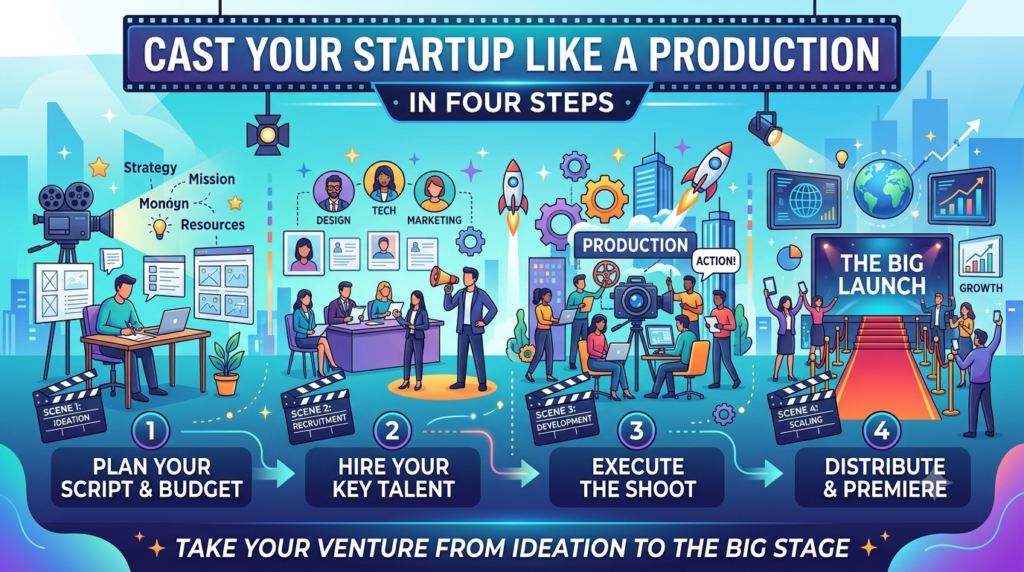
Treat your org chart like a call sheet, and run this exercise in one week.
- Inventory tasks. List every recurring task for each person on your team, from sprint planning to release notes.
- Tag each task. Mark it as execution (defined input, checkable output) or judgment (ambiguous input, accountable decision).
- Pilot on execution. Give AI the execution tasks for one sprint, and track a single metric: cycle time per task.
- Reinvest the hours. Move the saved time into judgment work, and publish the consent and data rules from the previous section.
Run the math with your own numbers. Here is an illustration with made-up figures: an engineer at $180,000 fully loaded who spends 25% of the week on boilerplate costs you $45,000 a year on that work. If AI halves that time, you recover about $22,500 of capacity per engineer. Multiply by your headcount, subtract tool costs, and you have an ROI figure you can defend in a board meeting.
Assign one owner per task category so that no AI output ships without a named person who reads it.
Expect friction. Some teammates will hold execution-heavy movie roles today, and the exercise will show them where their next growth step sits. Tell them early, pair them with review work, and give them first shot at the judgment-heavy movie roles that open up. The goal is not fewer movie roles. It is clearer ones: each person on your team either executes at machine speed or decides with full accountability.
Studios learned that AI replaces tasks before it replaces movie roles, and the roles that last own the decisions. Cast your team the same way, and every dollar of runway buys more finished shots.
Written By sumitmarketing.com