

A hundred people with placards outside a government building in Delhi generate more national attention in a single afternoon than most Series A startups generate in a full quarter of paid campaigns, and the mechanism behind that gap is worth stealing.
Why the Jantar Mantar Protest Outperforms Paid Distribution
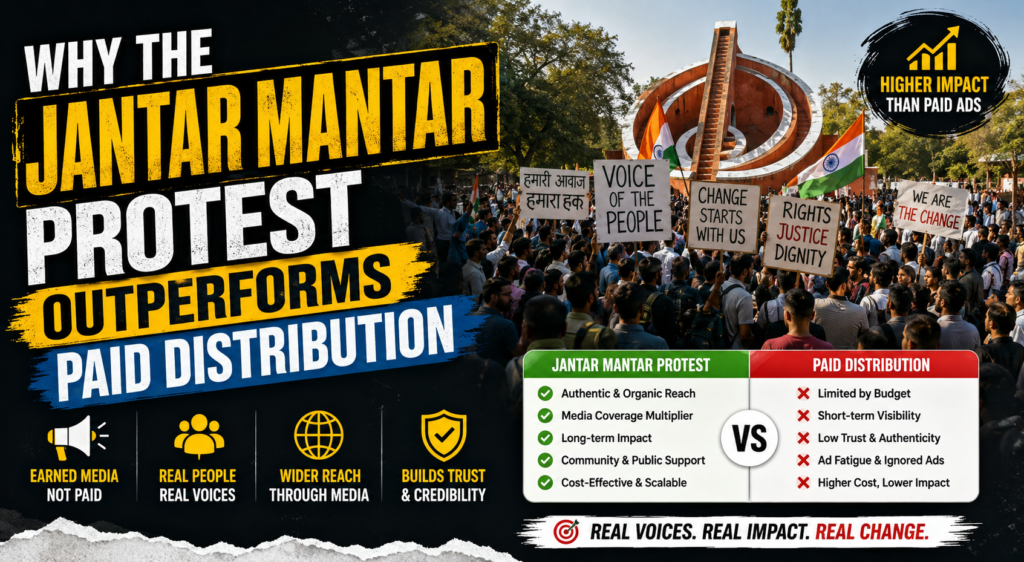
Jantar Mantar sits a few hundred meters from Parliament House in New Delhi, and Indian authorities designated it decades ago as the sanctioned site for public demonstrations. That single fact changes the economics of every Jantar Mantar protest. Organizers do not need to buy proximity to power — they inherit it. A founder trying to get a product in front of decision-makers usually pays for that proximity through ads, conferences, or cold outreach. A Jantar Mantar protest gets it for the cost of a permit and a few banners.
Compare the unit economics. A moderately sized Jantar Mantar protest with a few hundred participants and a clear, quotable demand routinely earns coverage across national television, wire services, and dozens of regional papers within 24 hours. Founders spend five- and six-figure sums on PR retainers chasing that same reach and often land a single mention buried in a roundup. The protest converts physical presence at a fixed, symbolically loaded location into media attention. Founders convert dollars into media attention. One of these channels has a materially lower cost per impression, and it is not the one venture-backed companies default to.
The Concentration Principle Behind Every Jantar Mantar Protest
Every effective Jantar Mantar protest works because it concentrates a diffuse grievance into one place, one time, and one visual. Diffuse pressure does not move institutions. Concentrated pressure does. Organizers who bring 5,000 supporters from across India to one 200-meter stretch of road on one specific day are not maximizing total reach — they are maximizing density at the exact coordinates where journalists, cameras, and officials already look.
Founders scatter their equivalent of that pressure across a dozen weak channels: a LinkedIn post here, a newsletter mention there, a conference booth next month. None of it concentrates. A Series A team preparing a launch, a funding announcement, or a policy pushback against a regulator gets more traction by picking one moment and one channel and pouring every resource into it than by spreading the same budget thin across many. The Jantar Mantar protest never happens at three locations on three different days — it happens once, at full intensity, where it counts. Founders who split a launch across staggered drips instead of one coordinated push are working against the same principle the protest organizers exploit.
What the Jantar Mantar Protest Teaches About Signal Design
A Jantar Mantar protest lives or dies on its signal, not its size. The protests that dominate headlines are the ones with a single sharp, repeatable demand — a specific bill, a specific resignation, a specific number — not the ones with the largest crowd but the vaguest message. Journalists need one sentence they can put in a headline. Officials need one demand they can respond to or reject. A blurry ask, however large the crowd behind it, gets far less coverage than a sharp one backed by fifty people.
This is the same discipline behind a strong Series A pitch or launch narrative. Investors and press do not remember “we’re building infrastructure for the future of X.” They remember one claim they can repeat to someone else. Founders who show up to a Jantar Mantar-style moment — a launch, a funding round, a public stand on a regulatory fight — with a fuzzy multi-point message dilute the exact attention they worked to concentrate. The organizers of any effective Jantar Mantar protest write their one-line demand before they write anything else. Founders should treat their core claim the same way: draft it first, and build every asset around defending that one line.
Sharp messaging also explains why coalitions outperform solo efforts at Jantar Mantar. A single-issue protest with one organizer rarely reaches critical mass, but the protests that shut down news cycles are almost always coalitions — multiple unions or advocacy groups that each bring their own members and press contacts, then combine under one banner and one demand. The organizing group does not need to fund the entire turnout; it needs partners who already have turnout and align them around a shared moment. A founder can copy this directly: partnering with a few adjacent companies or influential customers who already have committed audiences, then aligning one coordinated launch moment across all of them, produces the same multiplier a coalition brings to a Jantar Mantar protest, at the cost of coordination time rather than acquisition spend.
Timing reinforces this concentration. Every Jantar Mantar protest that lands in the national news cycle is scheduled against something specific — a parliamentary session, a court ruling, a policy deadline — rather than picked at random and hoped for. Organizers anchor the protest to a date that already has institutional attention pointed at it, then position their message to intersect that attention at the exact moment it peaks. Founders routinely skip this step and ship announcements on their own internal calendar instead of the market’s calendar. A funding round announced the same week as a major industry conference, or a launch timed against a competitor’s earnings call, borrows attention that already exists rather than trying to generate it from zero — the same trick that lets a Jantar Mantar protest ride a news cycle instead of competing against one.
The Real ROI Lesson From the Jantar Mantar Protest
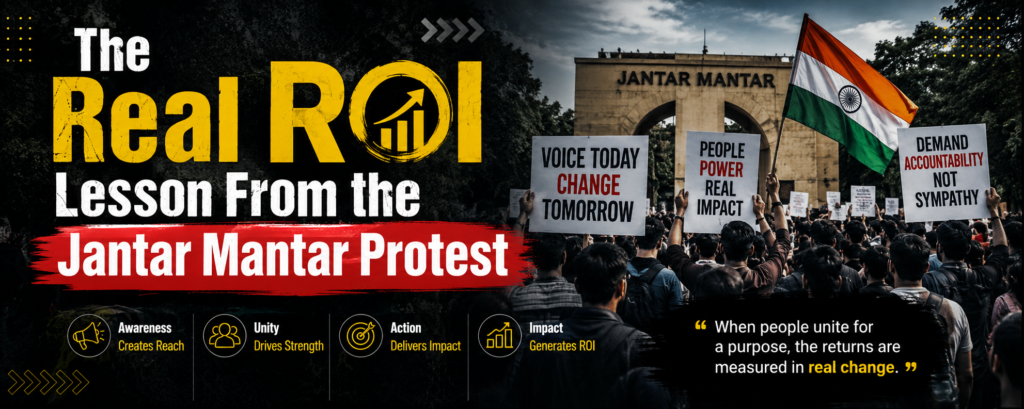
The clearest lesson a technical founder can take from the Jantar Mantar protest is that leverage beats budget. Organizers cannot outspend a government or a corporation, so they exploit a structural advantage instead: a location that guarantees media presence, a moment that guarantees institutional attention, and a message sharp enough to survive translation into a headline. None of that costs venture-scale money. It costs planning discipline.
Series A founders sitting on six or seven figures of runway often default to spending their way into attention because it feels controllable. But the actual return on a well-timed, well-concentrated, sharply worded push — a coordinated launch day, a single public letter to a regulator, a specific and quotable stance on an industry fight — regularly beats the return on the same dollars spread across a quarter of paid acquisition. The Jantar Mantar protest is proof that structural leverage, not spend, is what actually buys reach. A founder who identifies their own version of that fixed, high-attention location — the one channel, moment, or venue where the people who matter are already looking — gets more from a single sharp push than from months of diffuse spend.
Founders do not need a bigger budget to get the attention a Jantar Mantar protest gets for free — they need the same discipline: one location, one moment, one line worth repeating.
Written by sumitmarketing.com