

Google’s own documentation says local results rest on three factors: relevance, distance, and prominence. You can’t change distance, and you can’t brute-force the other two with code. Relevance depends on how completely your Business Profile and website describe what you sell. Prominence depends on reviews, citations, links, and brand mentions across the web. A local SEO company runs these workflows every day, with tooling and templates already built.
Technical founders tend to treat local search as a weekend project. You audit the site, add schema, claim the profile, and move on. Then the work stalls, because local search punishes inconsistency over months, not days. One mismatched phone number across directories, one unanswered review thread, or one location page that copies another city’s text can drop you out of the map pack.
Hiring a local SEO company buys you speed in a specific way: it removes the learning curve. A specialist who has already handled suspended profiles, duplicate listings, and wrong category choices will spot those problems in the first audit instead of the third month. Your engineers keep shipping product while the specialist works a channel outside their core skill.
The trade is simple. You pay a retainer, and you get back the engineering hours you would burn on trial and error. For a Series A team where each engineer-week carries a clear opportunity cost, that trade deserves a spreadsheet, not a gut call.
What a Local SEO Company Ships in the First 90 Days

A credible local SEO company works in a fixed sequence, and you can hold it to that sequence.
Weeks one and two: audit. The team inventories every listing of your business name, address, and phone number, then flags mismatches. It also reviews your Business Profile categories, hours, and services.
Weeks three to six: repair and build. The team merges duplicate listings, corrects citations, publishes location pages with original content, and adds LocalBusiness structured data to each page. You can verify the markup yourself with Google’s Rich Results Test. Engineers tend to like this phase because every deliverable is testable.
Weeks seven to twelve: compound. The team launches a review-request flow for real customers, publishes content tied to actual neighborhood queries, and tracks rankings by grid point instead of a single citywide number. Grid tracking matters because local rankings shift block by block. A first-place result at your office can become ninth place two miles away, and a single average hides that.
Ask any local SEO company for deliverables by week, not promises by month. Rankings move on Google’s schedule, so no honest vendor guarantees a position. Deliverables move on the vendor’s schedule, and you can audit them.
Pair the work with your own instrumentation. Tag direction requests, calls, and booking clicks from the profile with UTM parameters, and keep your primary phone number consistent across listings if you use call tracking. A local SEO company that resists measurement is telling you something about its results.
How to Model the ROI of a Local SEO Company
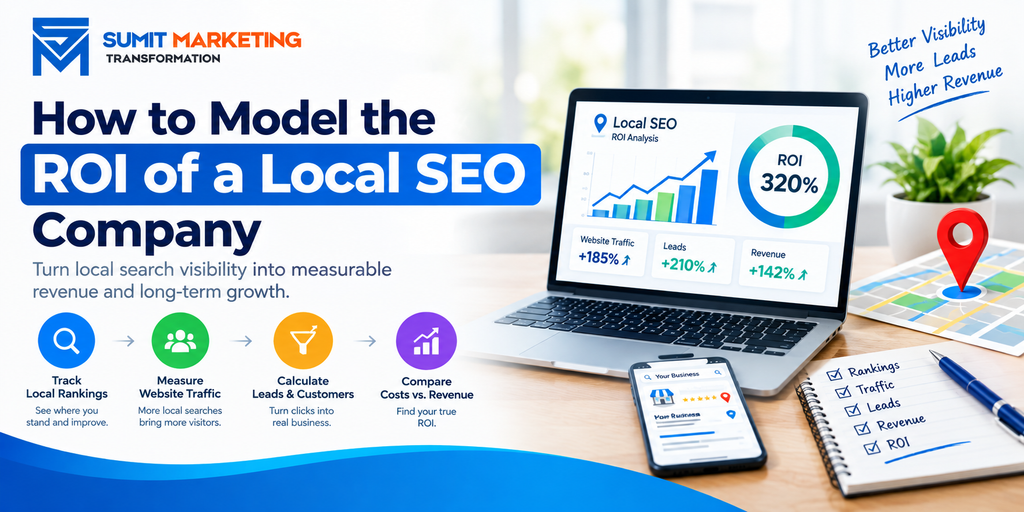
Skip industry averages. Build the model from your own funnel, because your close rate and contract value decide everything.
Use this formula:
Monthly return = (new qualified leads from local search × close rate × first-year revenue per customer) − retainer
Every input comes from your CRM or call log.
Here is an illustrative example with invented numbers. Replace them with yours. Say you run a regional device-installation startup. The retainer costs $3,000 a month. By month six, the channel adds 20 qualified leads monthly. You close 25% of them, and each customer brings $2,400 in first-year revenue. That gives you 5 customers and $12,000 in revenue against $3,000 in cost, a net of $9,000. These figures are assumptions, not benchmarks. Your numbers may look worse, and the model tells you that before you sign.
Compare the result against paid search. Paid search charges for every click, every month, indefinitely. Local visibility builds assets: reviews, citations, location pages, and links. When you stop paying a local SEO company, you keep most of those assets, though rankings can slip without maintenance. Plan for that maintenance cost.
Then set a kill criterion. Agree in writing on a break-even month, such as month five, and a minimum lead count by month six. If the profile and location pages miss that threshold, cut the contract or change the scope. A good local SEO company accepts that test, because it already tracks the same numbers.
How to Vet a Local SEO Company Before You Sign

Run a short technical screen.
Demand account ownership. You should own the Business Profile, analytics, and listings. If a vendor insists on owning them, walk away. You would lose your reviews and history on exit.
Call two reference clients in your category. A local SEO company that has only served restaurants may stumble on B2B or regulated services, where search intent and compliance rules differ.
Ask how they earn reviews. Google prohibits fake reviews and review gating, and violations can get a profile restricted or removed. Any vendor that offers purchased reviews puts your most valuable local asset at risk. Honest vendors build request flows that ask real customers.
Request a sample monthly report. Look for lead counts, calls, direction requests, and rankings by location. Reports built on impressions alone hide whether the work produced revenue.
Pin down scope. Count the locations, pages, and content pieces in the contract. Fuzzy scope becomes fuzzy invoices.
Ask what they would refuse to do. A strong local SEO company will tell you when your market has too few searches to justify the spend. That candor saves you the retainer.
Treat this like a technical hire. You would not onboard an engineer without checking references or reading their code, and a vendor that controls how customers find you deserves the same scrutiny.
Local search rewards the team that fixes the boring details first, and a local SEO company turns those details into a repeatable system while your engineers build the product. Run the ROI model with your own funnel numbers, set the month-six kill criterion, and sign only with the vendor that accepts both.
Written By sumitmarketing.com