
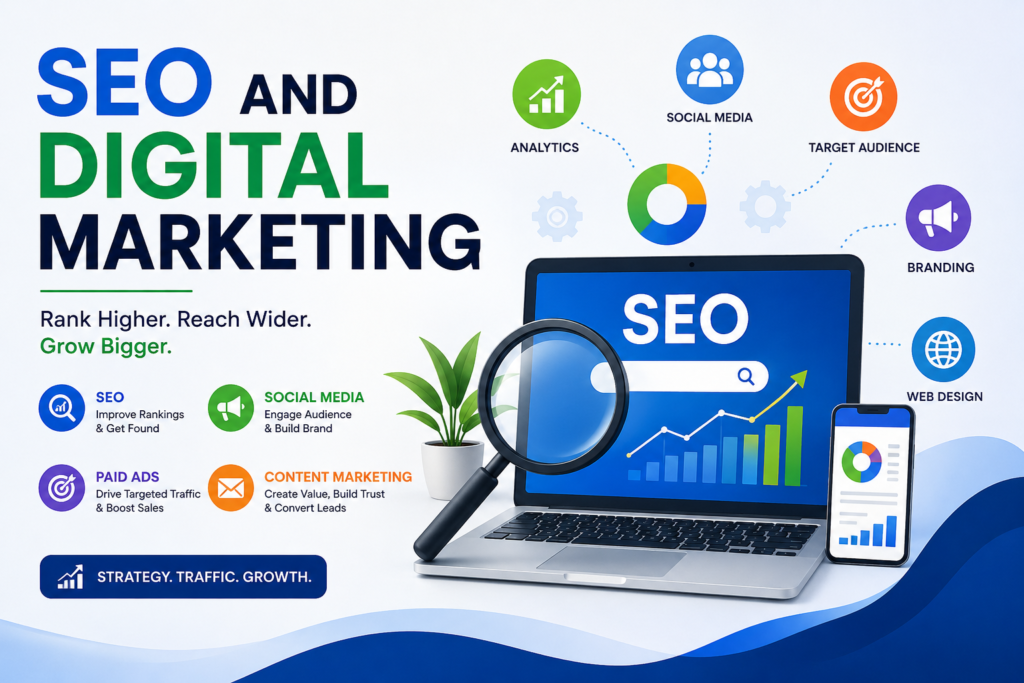
One well-ranked page can generate more qualified pipeline than three months of cold outbound, and that single fact should push every technical founder to treat SEO and digital marketing as an engineering problem rather than a marketing afterthought.
SEO and Digital Marketing Compound While Paid Acquisition Decays
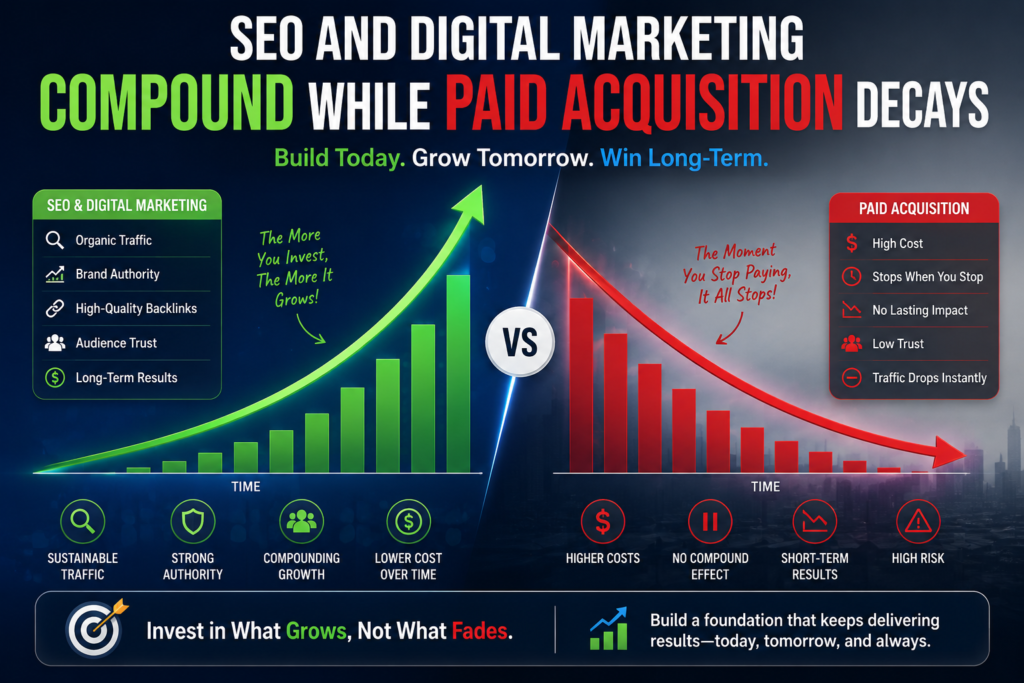
Paid acquisition behaves like rent. You pay for a click, you get a visitor, and the moment you stop paying, the visitor stops arriving. SEO and digital marketing work the opposite way: you invest engineering and content effort once, and the resulting page keeps earning traffic for months or years. A founder who redirects even 20% of the paid budget toward SEO and digital marketing builds an asset that survives budget cuts, algorithm shifts in the ad auction, and CAC inflation that hits every category eventually.
This matters most at Series A because runway math punishes anything that doesn’t compound. Your board wants to see CAC trending down and LTV:CAC trending up, and SEO and digital marketing move both numbers in your favor over a 12-to-18-month horizon. Paid search and paid social can move fast, but they rarely move your baseline. Organic search does. A developer tool company that ranks for “postgres connection pooling” or “webhook retry logic” captures buyers who are already mid-problem, not buyers who need to be interrupted with an ad. That difference in intent quality shows up directly in close rate, and close rate is the lever investors actually care about.
Technical founders often assume SEO and digital marketing require a large content team. They don’t. They require a handful of pages that answer the exact questions your ideal customer types into a search bar right before they buy. Ten precise pages built around SEO and digital marketing fundamentals will outperform a hundred generic blog posts that nobody searches for.
SEO and Digital Marketing Turn Product Data Into a Distribution Asset
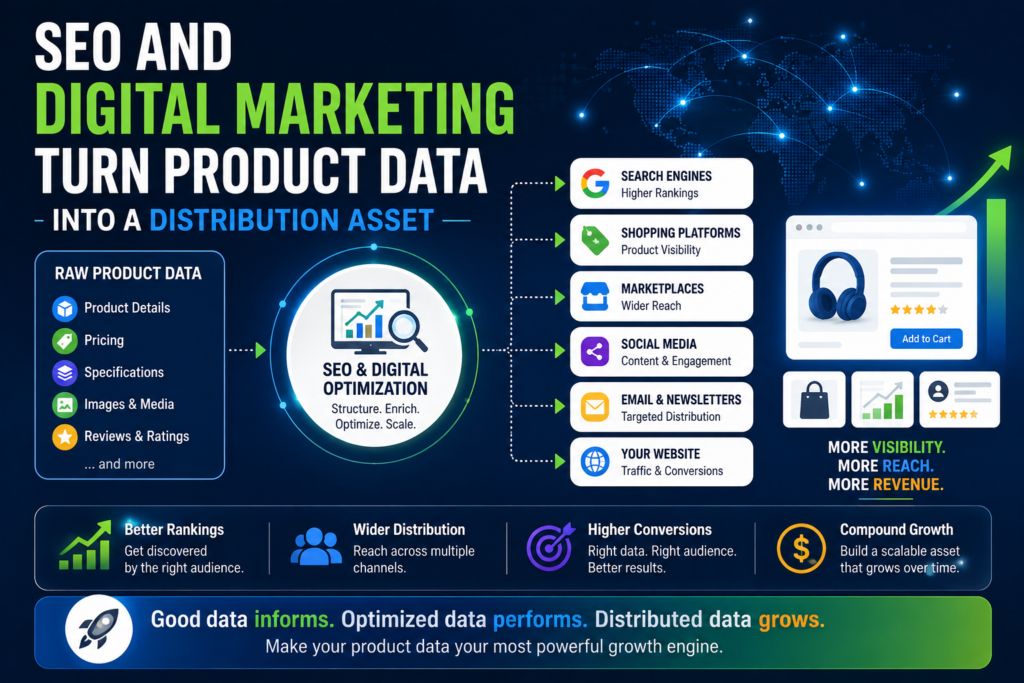
Most Series A companies sit on product data they never expose publicly: API documentation, benchmark results, integration guides, error message explanations, changelogs. Every one of these becomes a distribution channel when you apply SEO and digital marketing thinking to it. Documentation pages rank because they answer narrow, high-intent queries with precision that marketing copy can’t match, and developers trust documentation more than they trust a landing page.
Stripe, Twilio, and Vercel didn’t win developer mindshare through display ads. They won it by making SEO and digital marketing part of the product surface itself: every error code, every API reference, every quickstart guide became a page that search engines could rank and developers could find. You don’t need their headcount to copy the strategy. You need someone on your team, technical or otherwise, who treats your public documentation as a growth channel and applies basic SEO and digital marketing structure to it, meaning clear headers, answered questions, and internal links that guide a reader from a narrow technical query toward your product.
This is the fastest path to organic pipeline for a technical company, because the content already exists in your engineers’ heads. SEO and digital marketing, in this context, mostly means packaging knowledge you already have into a format search engines and humans can both parse.
SEO and Digital Marketing Reduce Your Blended Cost of Acquisition
Blended CAC is the metric that determines your next round’s valuation more than almost anything else, and SEO and digital marketing are the cheapest lever you have to bring that number down. A paid channel might cost you $150 per qualified lead indefinitely. An organic page, once it ranks, can produce leads at a marginal cost that approaches zero, because you already paid for the content creation and the ranking work up front.
Run the math on your own funnel. Take your current paid CAC, then estimate how many organic visitors a ranking page in your category typically pulls per month, then divide your one-time production cost by twelve months of that traffic. In nearly every B2B SaaS category, SEO and digital marketing beat paid channels on cost within six to nine months, and the gap widens every month after that because the paid cost never drops while the organic page keeps earning.
Investors who have sat through enough board meetings know the difference between a company that buys growth and a company that builds growth. SEO and digital marketing signal the second kind. When you can show a chart where organic traffic and organic-sourced pipeline both trend upward without a matching increase in ad spend, you’re telling your board a story about durable unit economics rather than a story about a leaky bucket you keep refilling.
SEO and Digital Marketing Force Discipline That Improves the Whole Funnel
The unexpected benefit of taking SEO and digital marketing seriously isn’t just traffic. It’s the discipline the process imposes on your positioning. To rank for a query, you have to answer it better than every competing page, and answering it better forces you to articulate your product’s value with a precision that vague marketing copy never demands. Founders who commit to SEO and digital marketing often discover their sales deck gets sharper as a side effect, because writing for search intent trains you to lead with the customer’s problem instead of your feature list.
SEO and digital marketing also expose gaps in your funnel that nobody notices when leads come from warm intros or founder-led sales. When organic visitors land on a page and bounce, you see exactly where the story breaks. When they convert, you see exactly which argument worked. That feedback loop, driven by real search behavior instead of a survey or a sales call summary, gives you data your competitors won’t have unless they invest in SEO and digital marketing with the same rigor.
Treat this as a system, not a project. Assign clear ownership, set a monthly cadence for publishing and updating pages, and track organic-sourced pipeline as its own line in your revenue dashboard next to paid and outbound. Companies that isolate SEO and digital marketing as “content marketing’s job” tend to under-invest and under-measure it. Companies that treat SEO and digital marketing as a growth engineering function tend to compound it.
Your competitors are either building this asset right now or ignoring it entirely, and either way that gap becomes permanent the longer you wait. Start with ten pages, measure what search brings you in ninety days, and let the data decide how much further you go.
Written By sumitmarketing.com