
Series A teams face a familiar squeeze. The board wants pipeline, the runway has a fixed length, and paid channels charge you for every click, forever. Google Maps SEO, Google Maps SEO works differently. You earn placement in the local pack and Maps results, and that placement keeps working while you ship product.
Not every startup qualifies, so here is the boundary. Google Maps SEO pays off when customers need to find a physical location or a business that serves a defined area. That covers clinics, fintechs with branches, hardware and logistics companies with depots, fitness and coworking operators, field-service platforms, and B2B companies that run a showroom, lab, or demo center. If you sell pure SaaS to remote buyers, skip this channel and spend your hours elsewhere.
For qualifying companies, the logic is simple. Google Maps SEO, A person who searches Maps for “urgent care near me” or “forklift rental” carries intent that a blog reader rarely matches. That person wants a phone number, a route, or an appointment, and a Google Business Profile hands over all three on one card. Each action maps to a trackable event. The Performance report inside the profile shows calls, direction requests, website clicks, and bookings, so you get conversion data before you build a single funnel.
Cost matters too. Claiming a Google Business Profile costs nothing. Your real spend goes to engineering time for landing pages, review operations, and content. One growth hire, or a founder with a few free hours a week, can run the whole program. That makes this one of the cheapest experiments on your roadmap.
The Three Levers You Control in Local Ranking
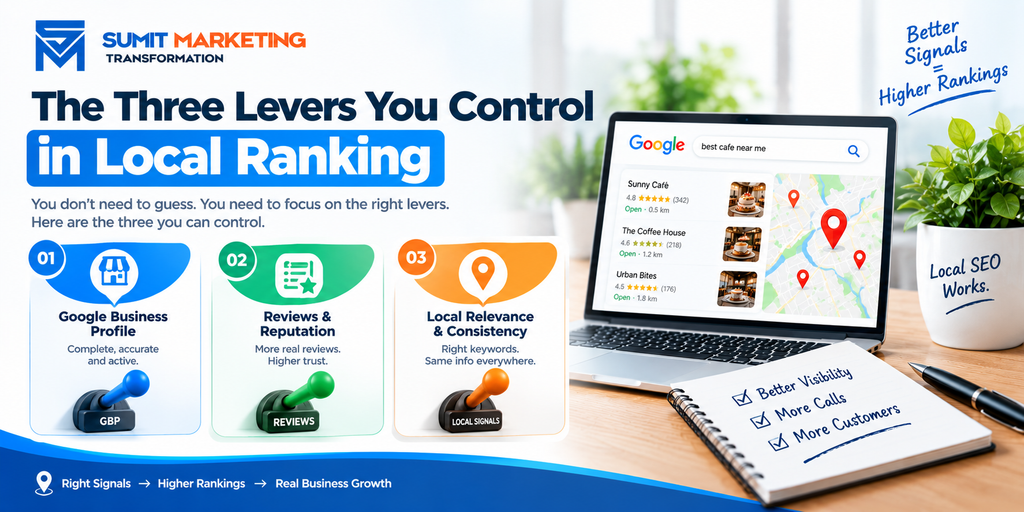
Google documents how local results rank: relevance, distance, and prominence. Google Maps SEO, Treat them as three variables in a scoring function. You cannot change distance after you sign a lease, but you can improve the other two.
Distance. Choose locations deliberately, and declare your service areas accurately. If you run a service-area business, list only the regions you serve. Padding the list with cities you never visit violates Google’s guidelines and invites a suspension.
Relevance. Relevance measures how well your profile matches the query. Pick the most specific primary category that describes your core business, then add secondary categories where they apply. Fill in every attribute, list your services and products, and write the description in the words your customers use. Never stuff keywords into the business name. Google’s guidelines require the name to match your real-world name, and violations lead to suspension.
Prominence. Prominence reflects how well known you are, online and offline. Google says review count and score influence it, along with links, articles, and directory presence. Reviews give you the fastest lever to pull. Ask every customer at the moment of success, such as after onboarding, after delivery, or after the appointment, and send a direct link to your review form. Reply to every review, including the negative ones, within a business day. Do not pay or reward people for reviews, because Google prohibits that.
Engineers will recognize the pattern. Relevance works like your schema, prominence works like your reputation graph, and distance works like a constant. Fix the two variables you control, and Google Maps SEO compounds as your review count and profile data grow.
A 30-Day Sprint to Ship Your Profile
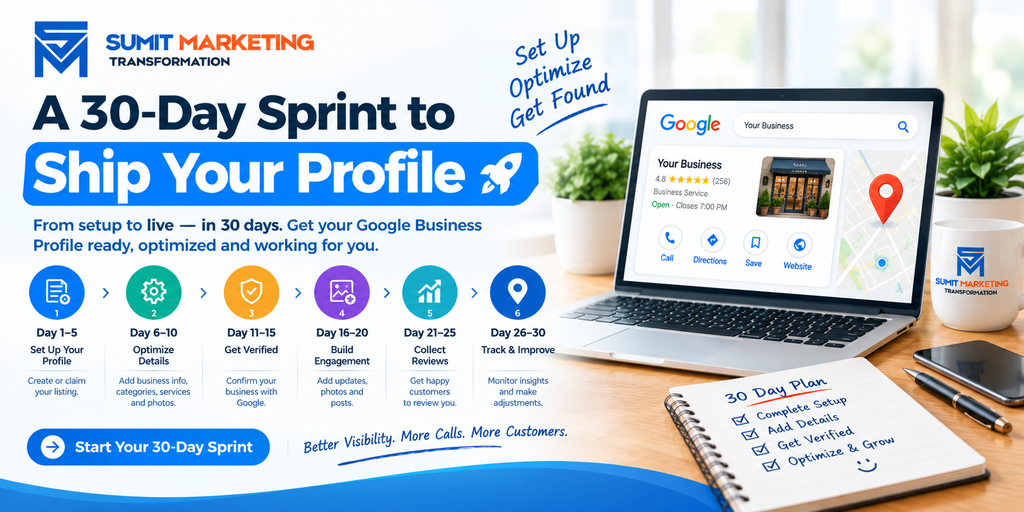
Treat the first month like a sprint with four deliverables.
Week 1: foundation. Claim and verify every location. Audit your name, address, and phone number (NAP) across your website, LinkedIn, Crunchbase, and the major directories, and fix every mismatch. Build one landing page per location and add LocalBusiness structured data, which schema.org supports. Link that page from the profile, and tag the link with UTM parameters so your analytics separate Maps traffic from organic search.
Week 2: content. Upload real photos of your entrance, office, team, and product. Add services, products, hours, and special hours. Publish your first posts. Stock images add nothing, and real photos help a searcher decide whether to visit.
Week 3: reviews. Build the review request into your product or CRM. Google Maps SEO, Trigger an email or SMS after a defined milestone, and include a short review link. Assign one owner for replies, and give that owner a response template for the common cases, such as praise, a billing complaint, or a service failure.
Week 4: measure and iterate. Read the Performance data and compare calls and direction requests against your baseline. Change one variable at a time, such as the primary category, the hero photo, or the description, and give each change enough time to show up in the numbers. Google’s reporting lags, so do not judge a change after two days.
Here is the ROI math, using illustrative numbers rather than a benchmark. Google Maps SEO, Suppose a profile drives 40 calls a month, a quarter of those callers book, and each booking brings in $150. That equals 10 bookings and $1,500 a month from one location. Replace each figure with your own, then compare the result to your paid acquisition cost. If your numbers clear that bar at one location, you have a case to roll the playbook out to the rest.
Measure Google Maps SEO Like an Engineer
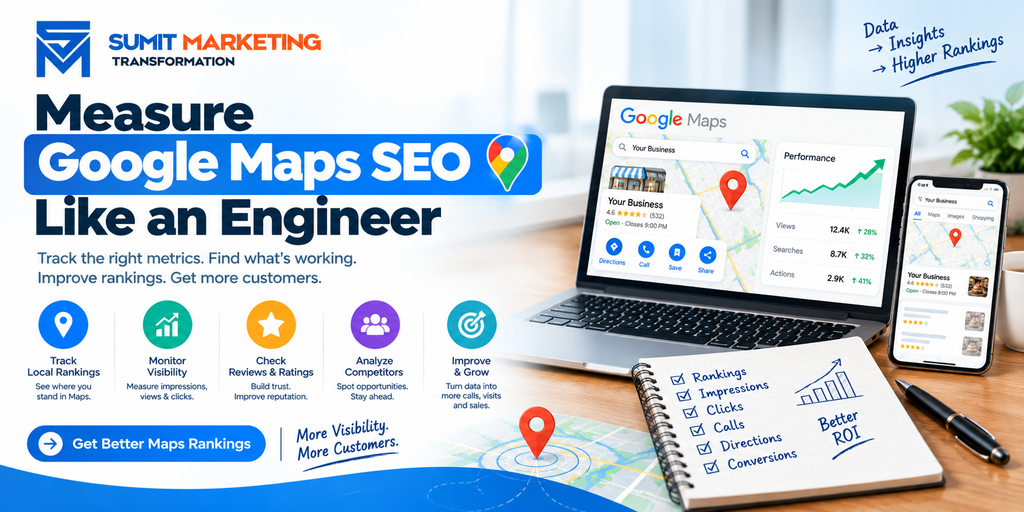
Marketers report impressions. Engineers should report cost per booked customer. Google Maps SEO, Start with five metrics: calls, direction requests, website clicks, bookings, and review velocity (new reviews per month). Add average rating and your local-pack position for the five queries that matter most to your business.
Position needs care. Local results change with the searcher’s location, so a single rank check from your office misleads you. Use a grid-based rank tracker, which samples positions across a map around your location. Local Falcon, BrightLocal, and Whitespark all offer versions of this. Pair the grid data with call tracking if you can, and pipe booked-customer data from your CRM back to each location. That connection turns a vanity number into a cost per acquisition.
Know the failure modes before you start:
- Google suspends profiles that break its guidelines, so keep your name, address, and categories honest.
- Duplicate or unverified listings split your signals, so merge or remove them.
- Fake reviews risk removal and suspension, and they erode trust with buyers who read them.
- No one can guarantee a ranking, so beware any vendor who does.
- Reviews reflect your product, and no tactic repairs a service customers dislike.
Set a decision rule before you spend an hour. Run the program on one location for one quarter. Compare your cost per booked customer to your paid channels. If it beats them, scale the playbook to the next location. Google Maps SEO, If it fails, you spent a few engineering days and a few hours a week, and you can shut it down with a clear number to justify the decision.
Treat Google Maps SEO as an experiment with a start date, a baseline, and a kill criterion. Run it for one quarter and let your cost per booked customer set the budget.
Written By sumitmarketing.com