
Your engineers ship a feature in two weeks, yet your pipeline stalls for two quarters because nobody owns demand.
Online Marketing Services Buy You Speed You Cannot Hire
A full-time marketing hire takes months before it produces anything. You write the job description, interview for several weeks, wait out a notice period, and then give the new hire time to learn your product. Check that timeline against your own last hire. Meanwhile, your runway shrinks every month.
Online marketing services compress that sequence. A good agency or specialist contractor already owns the playbooks, tool licenses, and creative templates. You sign a scope, share your analytics access, and launch campaigns in weeks instead of quarters.
You already understand this tradeoff. You rent cloud infrastructure instead of racking servers because the rented version ships sooner and shows you what you need before you commit capital. Online marketing services work the same way. You rent a tested capability, measure the output, and decide later whether to build it in-house.
Speed also protects your learning rate. At Series A, you still test your positioning. Which buyer persona responds? Which channel produces qualified demos? A team of specialists can run several channel experiments in the time one generalist runs a single one. Every experiment tells you where to place the next dollar, and a hire who spends three months onboarding cannot match that pace.
Run the ROI Math Before You Sign

Founders who distrust marketing usually distrust it because nobody showed them the arithmetic. online marketing services, So run it. The model below uses my assumptions, not industry benchmarks. Replace every number with your own.
Suppose your product sells at $24,000 in annual contract value with a 70% gross margin. You spend $15,000 per month on a paid campaign, fees included, and it produces 150 leads. If 10% of those leads become opportunities, you get 15 opportunities. If 20% of those opportunities close, you win 3 customers.
Those 3 customers bring $72,000 in annual contract value and $50,400 in gross profit. You spent $15,000 to win them, so your acquisition cost is $5,000 per customer. Each customer returns $16,800 in annual gross profit, which means you recover the $5,000 in roughly 3.6 months. That calculation excludes your sales team’s salaries, so add them before you celebrate. Fully loaded payback will run longer.
Now compare the alternative. Assume a senior marketer costs $150,000 in salary, online marketing services, plus roughly 25% in taxes and benefits, plus tool subscriptions. That puts the annual cost near $190,000 before the hire runs a single campaign. That number is also an assumption, so substitute your market’s rates. The point stands regardless of the exact figures: a hire commits you to a fixed cost before you know which channel works, while online marketing services let you scale spend up or down in 30-day increments.
Set kill criteria before you start. If a channel misses your payback target after 90 days, you cut it. Fixed targets turn marketing from a belief system into an experiment, and technical founders already know how to run experiments.
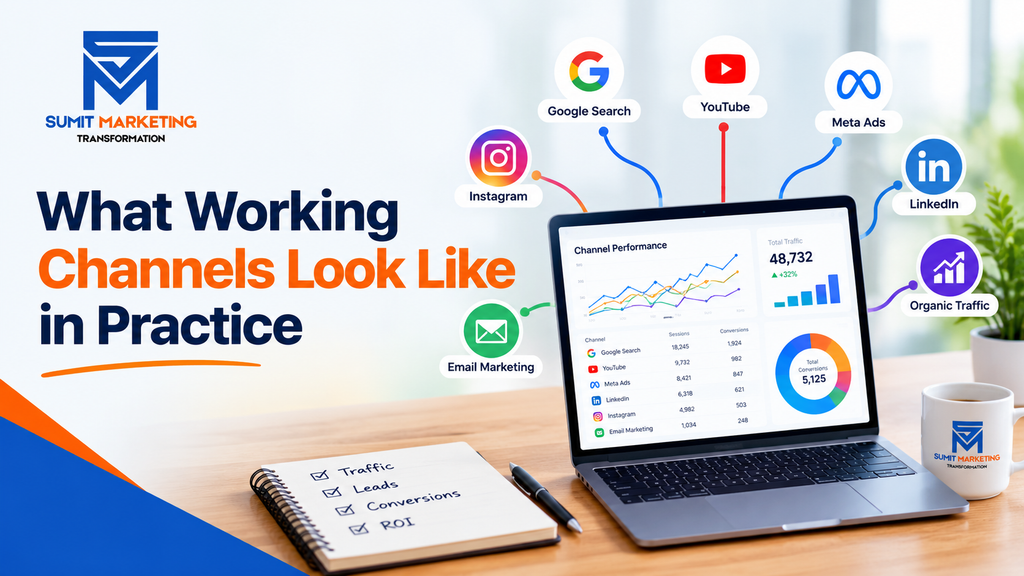
What Working Channels Look Like in Practice
Two well-known companies show how a repeatable system beats scattered effort.
Dropbox built a referral program that gave extra storage to users who invited friends. The company turned existing customers into a distribution channel, and the reward cost Dropbox little because storage was cheap to give away. The mechanism worked because someone designed the loop, measured it, and tuned it.
HubSpot built its early reputation on a content library and free tools. online marketing services, Its Website Grader gave marketers a useful result in exchange for their contact details, which fed the sales team a steady stream of qualified leads. HubSpot treated content as a system with inputs and outputs, not as a creative hobby.
Both examples carry the same lesson. Marketing at its best looks like engineering: you define a loop, instrument it, and iterate on the numbers. Both companies also had to build that capability from scratch, and building it took time and money they could not spend elsewhere.
You can skip some of that cost. Competent online marketing services arrive with an instrumented process: a tracking plan, a testing cadence, and a reporting format. You will not match the scale of those two companies. You can borrow their discipline in your first 90 days, though, and that discipline matters more than any single tactic.
Pick channels that fit your buyer. If you sell to developers, technical content, documentation, and community presence usually beat cold outbound ads. If you sell to operations leaders, paid search and LinkedIn campaigns often reach them faster. Ask any vendor to explain why their channel suits your buyer, and walk away from anyone who recommends the same package to every client.
Buy Online Marketing Services Like You Buy Engineering Vendors

Most bad agency relationships fail for reasons you can prevent. Treat the vendor selection like a technical procurement and demand the same rigor you would apply to a security audit.
First, insist on a 90-day scope with one primary metric. Choose qualified pipeline or booked demos, not impressions or followers. Vanity metrics let a vendor look busy while your runway burns.
Second, own the accounts. Your ad platforms, analytics, and CRM should sit under your company’s login, with the vendor holding delegated access. If the relationship ends, you keep every asset, audience, and data point.
Third, read the raw data weekly. Ask for dashboard access instead of a monthly slide deck. If a vendor resists showing you the underlying numbers, treat that as a red flag.
Fourth, start with one channel. Spreading a modest budget across five channels guarantees you learn nothing from any of them. Prove one channel, then add the next.
Fifth, assign one internal owner. A founder or product lead should spend a few hours each week on feedback, messaging approvals, and product context. Vendors cannot write about your architecture or your edge cases without you, and the best online marketing services depend on that input.
Sixth, plan the handoff from day one. Ask the vendor to document every playbook, audience, and test result. When your spend reaches a level that justifies a full-time hire, you can bring the function in-house with a proven system instead of a blank page. In that scenario, your online marketing services partner becomes the training ground for your first marketing leader, who will start with data instead of guesses.
Technical founders often wait too long to treat distribution as a first-class problem. Waiting costs runway you cannot recover, and no feature release will fix a demand gap.
Rent the capability now, measure it against hard payback numbers, and hire only after the data tells you what to hire for. Online marketing services will not replace a strong product, but they will put that product in front of buyers before your runway runs out.
Written By sumitmarketing.com